Currently I am focused on building on the work I and others did last year in setting up Kubernetes for more of MetaCPAN (and other projects) to host on.
Last week I organised the Road map which was the first thing we ran through this morning. I was very fortunate to spend the day with Joel and between us we managed to setup:
- Hetzner (hosting company) volumes auto provisioning in the k8s cluster
- Postgres cluster version (e.g. with replication between nodes)
I had a few discussions with other projects interested in hosting and this has helped us start work on what we need to be able to provision and how.. especially with attached storage which has been some what of a challenge but we are heading towards a solution.
MetaCPAN indexing stopped... again.. because our bm-mc-01 server had disk issues (been going on for a couple of weeks). Whilst Oalders shutdown the server I switched over the puppet setup so bm-mc-02 was the primary postgres DB and cronjobs which will keep us going for a while longer, but does mean we are reliant on 2 servers which is not ideal from a failover point of view. Oalders has raised an issue with the hosting company... so we'll see how that works out.
Spoiler Alert: This weekly challenge deadline is due in a few days from now (on April 28, 2024 at 23:59). This blog post provides some solutions to this challenge. Please don’t read on if you intend to complete the challenge on your own.
You are given a square matrix, $matrix.
Write a script to find if the given matrix is X Matrix.
A square matrix is an X Matrix if all the elements on the main diagonal and antidiagonal are non-zero and everything else are zero.
Example 1
Input: $matrix = [ [1, 0, 0, 2],
                   [0, 3, 4, 0],
                   [0, 5, 6, 0],
                   [7, 0, 0, 1],
                 ]
Output: true
Example 2
Input: $matrix = [ [1, 2, 3],
                   [4, 5, 6],
                   [7, 8, 9],
                 ]
Output: false
Example 3
Input: $matrix = [ [1, 0, 2],
                   [0, 3, 0],
                   [4, 0, 5],
                 ]
Output: true
The matrix items on the main diagonal (from top left to bottom right) are those whose row index is equal to the column index, such as @matrix[0][0] or @matrix[1][1], i.e. items 1, 3, 6, and 1 in the first example above.
The matrix items on the anti-diagonal (from top right to bottom left) are those whose row index plus the column index is equal to the matrix size - 1, such as @matrix[0][3] or @matrix[1][2], i.e. items 2, 4, 5 and 7 in the first example above.
We iterate over the items of the matrix using two nested loops. If an item on a diagonal or an anti-diagonal (see above) is zero, then we return False; if an item not on a diagonal or an anti-diagonal is not zero, then we also return False. If we arrive at the end of the two loops, then we have an X matrix and can return True.
sub is-x-matrix (@m) {
    my $end = @m.end; # end = size - 1
    for 0..$end -> $i {
        for 0..$end -> $j {
            if $i == $j or $i + $j == $end { # diag or antidiag
                return False if @m[$i][$j] == 0;
            } else {    # not diag or antidiag
                return False if @m[$i][$j] != 0;
            }
        }
    }
    # If we got here, it is an X-matrix
    return True;
}

my @tests =
    [ [1, 0, 0, 2],
      [0, 3, 4, 0],
      [0, 5, 6, 0],
      [7, 0, 0, 1],
    ],
    [ [1, 2, 3],
      [4, 5, 6],
      [7, 8, 9],
    ],
    [ [1, 0, 2],
      [0, 3, 0],
      [4, 0, 5],
    ];
for @tests -> @test {
    printf "[%-10s...] => ", "@test[0]";
    say is-x-matrix @test;
}
Note that we display only the first row of each test matrix for the sake of getting a better formatting. This program displays the following output:
$ raku ./x-matrix.raku
[1 0 0 2   ...] => True
[1 2 3     ...] => False
[1 0 2     ...] => True
This is a port to Perl of the above Raku program. Please refer to the previous section if you need further explanations.
use strict;
use warnings;
use feature 'say';

sub is_x_matrix {
    my $m = shift;
    my $end = scalar @{$m->[0]} - 1; # $end = size - 1
    for my $i (0..$end) {
        for my $j (0..$end) {
            if ($i == $j or $i + $j == $end) { # diag or antidiag
                return "false" if $m->[$i][$j] == 0;
            } else {    # not diag or antidiag
                return "false" if $m->[$i][$j] != 0;
            }
        }
    }
    # If we got here, it is an X-matrix
    return "true";
}

my @tests = (
    [ [1, 0, 0, 2],
      [0, 3, 4, 0],
      [0, 5, 6, 0],
      [7, 0, 0, 1],
    ],
    [ [1, 2, 3],
      [4, 5, 6],
      [7, 8, 9],
    ],
    [ [1, 0, 2],
      [0, 3, 0],
      [4, 0, 5],
    ]
    );
for my $test (@tests) {
    printf "[%-10s...] => ", "@{$test->[0]}";
    say is_x_matrix $test;
}
This program displays the following output:
$ perl ./x-matrix.pl
[1 0 0 2   ...] => true
[1 2 3     ...] => false
[1 0 2     ...] => true
The next week Perl Weekly Challenge will start soon. If you want to participate in this challenge, please check https://perlweeklychallenge.org/ and make sure you answer the challenge before 23:59 BST (British summer time) on May 5, 2024. And, please, also spread the word about the Perl Weekly Challenge if you can.
]]>Spoiler Alert: This weekly challenge deadline is due in a few days from now (on April 28, 2024 at 23:59). This blog post provides some solutions to this challenge. Please don’t read on if you intend to complete the challenge on your own.
You are given two sentences, $line1 and $line2.
Write a script to find all uncommon words in any order in the given two sentences. Return ('') if none found.
A word is uncommon if it appears exactly once in one of the sentences and doesn’t appear in other sentence.
Example 1
Input: $line1 = 'Mango is sweet'
       $line2 = 'Mango is sour'
Output: ('sweet', 'sour')
Example 2
Input: $line1 = 'Mango Mango'
       $line2 = 'Orange'
Output: ('Orange')
Example 3
Input: $line1 = 'Mango is Mango'
       $line2 = 'Orange is Orange'
Output: ('')
We're given two sentences, but the words of these sentences can be processed as one merged collection of words: we only need to find words that appear once in the overall collection.
We use the words method to split the sentences into individual words. Then, in the light of the comment above, we merge the two word lists into a single Bag, using the (+) or ⊎ Baggy addition operator,infix%E2%8A%8E). Finally, we select words that appear only once in the resulting Bag.
sub uncommon ($in1, $in2) {
    my $out = $in1.words ⊎ $in2.words; # Baggy addition
    return grep {$out{$_} == 1}, $out.keys;
}

my @tests = ('Mango is sweet', 'Mango is sour'),
            ('Mango Mango', 'Orange'),
            ('Mango is Mango', 'Orange is Orange');
for @tests -> @test {
    printf "%-18s - %-18s => ", @test[0], @test[1];
    say uncommon @test[0], @test[1];
}
This program displays the following output:
$ raku ./uncommon.raku
Mango is sweet     - Mango is sour      => (sour sweet)
Mango Mango        - Orange             => (Orange)
Mango is Mango     - Orange is Orange   => ()
This is a port to Perl of the above Raku program. We use a hash instead of a Bag to store the histogram of words.
use strict;
use warnings;
use feature 'say';

sub uncommon {
    my %histo;
    $histo{$_}++ for map { split /\s+/ } @_;
    my @result = grep {$histo{$_} == 1} keys %histo;
    return @result ? join " ", @result : "''";
}

my @tests = ( ['Mango is sweet', 'Mango is sour'],
              ['Mango Mango', 'Orange'],
              ['Mango is Mango', 'Orange is Orange'] );
for my $test (@tests) {
    printf "%-18s - %-18s => ", $test->[0], $test->[1];
    say uncommon $test->[0], $test->[1];
}
This program displays the following output:
$ perl ./uncommon.pl
Mango is sweet     - Mango is sour      => sour sweet
Mango Mango        - Orange             => Orange
Mango is Mango     - Orange is Orange   => ''
The next week Perl Weekly Challenge will start soon. If you want to participate in this challenge, please check https://perlweeklychallenge.org/ and make sure you answer the challenge before 23:59 BST (British summer time) on May 5, 2024. And, please, also spread the word about the Perl Weekly Challenge if you can.
]]>Yes, we're back we'd like to announce this year's LPW:
WHEN: TBC, most likely Saturday 26th October 2024
WHERE: TBC
Please register and submit talks early - it gives us a better idea of numbers. The date is tentative, depending on the venue, but we'd like to aim for the 26th October 2024.
This will be the 20th anniversary of LPW (in terms of years, not number of events). We might try to do something special...
The venue search is currently in progress. The 2019 venue has turned into a boarding school so we can't use that any more due to safeguarding issues. We don't want to go back to the University of Westminster so we are searching for a venue.
If you can help out with the venue search that would be great - does your company have a large enough space to host us? Are you part of a club, organisation, university, school, etc that can provide space? Have you been to an event in central London recently that might be a suitable venue?
Here's roughly what we're looking for. Obviously requirements are a little flexible:
- Central London (Zone 1)
- Saturday 26th October 2024
- Available 9am to 5pm (with access 8am to 6pm)
- A main lecture hall / room with presentation facilities
+ To seat at least 100 people + With PA system
- Optional second room, also with presentation facilities
+ To seat at least 35 people- Breakout room (optional) / reception / welcome area for stands/registration
- Video facilities are not required
- Catering facilities are required
+ Tea, coffee, water, soft drinks, small snacks throughout the day
+ Possibly lunch provided on site with dietary requirement options
~ However if lunch is a significant cost we will leave people to sort that out themselves
Please register, submit talks, think about possible venues, and let us know via email.
Cheers!
The LPW Organisers
Spoiler Alert: This weekly challenge deadline is due in a few days from now (on April 21, 2024 at 23:59). This blog post provides some solutions to this challenge. Please don’t read on if you intend to complete the challenge on your own.
You are given a string, $str containing alphanumeric characters and array of strings (alphabetic characters only), @str.
Write a script to find the shortest completing word. If none found return empty string.
A completing word is a word that contains all the letters in the given string, ignoring space and number. If a letter appeared more than once in the given string then it must appear the same number or more in the word.
Example 1
Input: $str = 'aBc 11c'
       @str = ('accbbb', 'abc', 'abbc')
Output: 'accbbb'

The given string contains following, ignoring case and number:
a 1 times
b 1 times
c 2 times

The only string in the given array that satisfies the condition is 'accbbb'.
Example 2
Input: $str = 'Da2 abc'
       @str = ('abcm', 'baacd', 'abaadc')
Output: 'baacd'

The given string contains following, ignoring case and number:
a 2 times
b 1 times
c 1 times
d 1 times

The are 2 strings in the given array that satisfies the condition:
'baacd' and 'abaadc'.

Shortest of the two is 'baacd'
Example 3
Input: $str = 'JB 007'
       @str = ('jj', 'bb', 'bjb')
Output: 'bjb'

The given string contains following, ignoring case and number:
j 1 times
b 1 times

The only string in the given array that satisfies the condition is 'bjb'.
The task specification does not state it explicitly, but the examples show that we should ignore case when comparing letters.
In Raku, we'll use a Bag, which is a collection of distinct elements that each have an integer weight assigned to them signifying how many copies of that element are considered "in the bag", to store a histogram of the letter frequencies, both for the input test string and the words to which it should be compared. The good thing about it is that we obtain directly a histogram of the input letter list, and that can use the ⊆ Subset of or equal to operator,infix%E2%8A%86) to check directly the completing condition.
sub complete-word  ($in-str, @in-words) {
    my $letters = $in-str.comb.map({ .lc}).grep( /<[a..z]>/).Bag;
    my @result;
    for @in-words -> $word {
        push @result, $word if $letters ⊆ $word.comb.map({ .lc }).Bag;
    }
    return min(@result, :by( { $_.chars } ));
}

my @tests = ('aBc 11c', ('accbbb', 'abc', 'abbc')),
            ('Da2 abc', ('abcm', 'baacd', 'abaadc')),
            ('JB 007', ('jj', 'bb', 'bjb'));
for @tests -> @test {
    printf "%-8s - %-20s => ", @test[0], "@test[1]";
    say complete-word @test[0], @test[1];
}
This program displays the following output:
$ raku ./complete-wortd.raku
aBc 11c  - accbbb abc abbc      => accbbb
Da2 abc  - abcm baacd abaadc    => baacd
JB 007   - jj bb bjb            => bjb
This is a port to Perl of the above Raku program. We use a hash instead of a Bag to store the histogram of the input letters. The use of the subset operator is replaced by a simple loop to find out whether any letter of the input test string is missing (or in smaller number) in the input words.
use strict;
use warnings;
use feature 'say';

sub complete_word {
    my ($in_str, @in_words) = @_;
    my %letters;
    $letters{$_}++ for grep { $_ =~ /[a-z]/ } map { lc } split //, $in_str;
    my @result;
    WORD: for my $word (@in_words) {
        my %word_let;
        $word_let{$_}++ for map { lc } split //, $word;
        for my $k (keys %letters) {
            next WORD unless exists $word_let{$k};
            next WORD if $letters{$k} > $word_let{$k};
        }
        push @result, $word;
    }
    return (sort {length $a <=> length $b} @result)[0];
}

my @tests = ( ['aBc 11c', ['accbbb', 'abc', 'abbc']],
              ['Da2 abc', ['abcm', 'baacd', 'abaadc']],
              ['JB 007', ['jj', 'bb', 'bjb']]  );
for my $test (@tests) {
    printf "%-8s - %-10s => ", $test->[0], "$test->[1][0] ...";
    say complete_word $test->[0], @{$test->[1]};
}
This program displays the following output:
$ perl ./complete-wortd.pl
aBc 11c  - accbbb ... => accbbb
Da2 abc  - abcm ...   => baacd
JB 007   - jj ...     => bjb
The next week Perl Weekly Challenge will start soon. If you want to participate in this challenge, please check https://perlweeklychallenge.org/ and make sure you answer the challenge before 23:59 BST (British summer time) on April 28, 2024. And, please, also spread the word about the Perl Weekly Challenge if you can.
]]>I'm sure many of us are old enough and experienced enough to detect and ignore this type of attack. But in case you aren't (welcome!) or if you are feeling a bit out of practice, then please remember to only log in via the official PAUSE entry point.
]]>Spoiler Alert: This weekly challenge deadline is due in a few days from now (on April 21, 2024 at 23:59). This blog post provides some solutions to this challenge. Please don’t read on if you intend to complete the challenge on your own.
You are given an array of integers, @ints.
Write a script to find an integer in the given array that appeared 33% or more. If more than one found, return the smallest. If none found then return undef.
Example 1
Input: @ints = (1,2,3,3,3,3,4,2)
Output: 3

1 appeared 1 times.
2 appeared 2 times.
3 appeared 4 times.

3 appeared 50% (>33%) in the given array.
Example 2
Input: @ints = (1,1)
Output: 1

1 appeared 2 times.

1 appeared 100% (>33%) in the given array.
Example 3
Input: @ints = (1,2,3)
Output: 1

1 appeared 1 times.
2 appeared 1 times.
3 appeared 1 times.

Since all three appeared 33.3% (>33%) in the given array.
We pick the smallest of all.
We coerce the input array into a Bag, which is a collection of distinct elements that each have an integer weight assigned to them, signifying how many copies of that element are considered "in the bag". The good thing about it is that we obtain directly a histogram of the values in the input array. Note that we return Nil rather than undef when no solution because this is more in line with what Raku does in such cases.
sub thirty-three-pct (@in) {
    my $count = @in.elems;
    return Nil if $count == 0;
    my $limit = $count * .33;
    my $histo = @in.Bag;
    my @eligibles = grep { $histo{$_} > $limit }, $histo.keys;
    return @eligibles ?? @eligibles.min !! Nil;
}

my @tests = <1 2 3 3 3 3 4 2>, <1 2>, <1 2 3>,
            <1 2 1 2 1 2 1 2>, <1 2 3 4 1 2 3 4>;
for @tests -> @test {
    printf "%-18s => ", "@test[]";
    say thirty-three-pct @test;
}
This program displays the following output:
$ raku ./33-pct.raku
1 2 3 3 3 3 4 2    => 3
1 2                => 1
1 2 3              => 1
1 2 1 2 1 2 1 2    => 1
1 2 3 4 1 2 3 4    => Nil
This is a port to Perl of the above Raku program. We use a hash instead of a Bag to store the histogram of the input values.
use strict;
use warnings;
use feature 'say';

sub thirty_three_pct {
    my $count = scalar @_;
    return "Undef" if $count == 0;
    my $limit = $count * .33;
    my %histo;
    $histo{$_}++ for @_;
    my @eligibles = sort {$a <=> $b}
                    grep { $histo{$_} > $limit } keys %histo;
    return @eligibles ? $eligibles[0] : "Undef";
}

my @tests = ([<1 2 3 3 3 3 4 2>], [<1 2>], [<1 2 3>],
             [<1 2 1 2 1 2 1 2>], [<1 2 3 4 1 2 3 4>]);
for my $test (@tests) {
    printf "%-18s => ", "@$test";
    say thirty_three_pct @$test;
}
This program displays the following output:
$ perl ./33-pct.pl
1 2 3 3 3 3 4 2    => 3
1 2                => 1
1 2 3              => 1
1 2 1 2 1 2 1 2    => 1
1 2 3 4 1 2 3 4    => Undef
The next week Perl Weekly Challenge will start soon. If you want to participate in this challenge, please check https://perlweeklychallenge.org/ and make sure you answer the challenge before 23:59 BST (British summer time) on April 28, 2024. And, please, also spread the word about the Perl Weekly Challenge if you can.
]]>Update for the Science Track submissions, we have a small, but solid set of submissions and are expecting a few more. The Science Perl Committee is committed to helping anyone submitting a serious entry to succeed. If you're hesitating at all because you're afraid of getting rejected, please be reassured we want as many people to be part of this inaugural Science Track, as possible.
Please note, acceptable topics DO include white papers discussing implementation details of the Perl or Raku interpreters, experimental language features, implementations, benchmarks, etc.
I personally and strongly encourage you to submit an abstract to the Science Track. And if you don't want to write a paper, I strongly encourage you to submit a regular conference talk.
Brett Estrade (OODLER)
]]>try, extra_paired_delimiters) should be included in the :5.40
feature bundleSpoiler Alert: This weekly challenge deadline is due in a few days from now (on April 14, 2024 at 23:59). This blog post provides some solutions to this challenge. Please don’t read on if you intend to complete the challenge on your own.
You are given two arrays of integers, @source and @indices. The @indices can only contains integers 0 <= i < size of @source.
Write a script to create target array by insert at index $indices[i] the value $source[i].
Example 1
Input: @source  = (0, 1, 2, 3, 4)
       @indices = (0, 1, 2, 2, 1)
Output: (0, 4, 1, 3, 2)

@source  @indices  @target
0        0         (0)
1        1         (0, 1)
2        2         (0, 1, 2)
3        2         (0, 1, 3, 2)
4        1         (0, 4, 1, 3, 2)
Example 2
Input: @source  = (1, 2, 3, 4, 0)
       @indices = (0, 1, 2, 3, 0)
Output: (0, 1, 2, 3, 4)

@source  @indices  @target
1        0         (1)
2        1         (1, 2)
3        2         (1, 2, 3)
4        3         (1, 2, 3, 4)
0        0         (0, 1, 2, 3, 4)
Example 3
Input: @source  = (1)
       @indices = (0)
Output: (1)
The way the target array is constructed (as detailed in the examples) is somewhat weird, so that we cannot use array slices as I was originally hoping. We have to build the target array iteratively, item by item.
Also note that we are not told what to do if the @source and @indices arrays don't have the same size, so we will assume they have the same size.
In order to built the target array in accordance with the rules explained in the examples, the easiest is to use the splice routine, which can add, remove or replace elements of an array. In this specific case, we don't remove or replace items of the array (this is why the third parameter of the splice function call is set to 0), but just add one value at a time.
sub target-array (@source, @indices) {
    my @target;
    for 0..@source.end -> $i {
        splice @target, @indices[$i], 0,  @source[$i];
    }
    return @target;
}

my @tests = ( (0, 1, 2, 3, 4), (0, 1, 2, 2, 1) ),
            ( (1, 2, 3, 4, 0), (0, 1, 2, 3, 0) ),
            ( (1,), (0,) );
for @tests -> @test {
    printf "%-10s - %-10s => ", "@test[0]", "@test[1]";
    say target-array @test[0], @test[1];
}
This program displays the following output:
$ raku ./target-array.raku
0 1 2 3 4  - 0 1 2 2 1  => [0 4 1 3 2]
1 2 3 4 0  - 0 1 2 3 0  => [0 1 2 3 4]
1          - 0          => [1]
This is a port to Perl of the above Raku program. For our practical purpose, Perl's splice function behaves essentially the same way as Raku's splice routine.
use strict;
use warnings;
use feature 'say';

sub target_array  {
    my @source = @{$_[0]};
    my @indices = @{$_[1]};
    my @target;
    for my $i (0..$#source) {
        splice @target, $indices[$i], 0,  $source[$i];
    }
    return @target;
}

my @tests = ( [ [0, 1, 2, 3, 4], [0, 1, 2, 2, 1] ],
              [ [1, 2, 3, 4, 0], [0, 1, 2, 3, 0] ],
              [ [1,], [0,] ] );
for my $test (@tests) {
    printf "%-10s - %-10s => ", "@{$test->[0]}", "@{$test->[1]}";
    say join " ", target_array $test->[0], $test->[1];
}
This program displays the following output:
$ perl ./target-array.pl
0 1 2 3 4  - 0 1 2 2 1  => 0 4 1 3 2
1 2 3 4 0  - 0 1 2 3 0  => 0 1 2 3 4
1          - 0          => 1
The next week Perl Weekly Challenge will start soon. If you want to participate in this challenge, please check https://perlweeklychallenge.org/ and make sure you answer the challenge before 23:59 BST (British summer time) on April 21, 2024. And, please, also spread the word about the Perl Weekly Challenge if you can.
]]>Spoiler Alert: This weekly challenge deadline is due in a few days from now (on April 14, 2024 at 23:59). This blog post provides some solutions to this challenge. Please don’t read on if you intend to complete the challenge on your own.
You are given a string, $str, made up of only alphabetic characters [a..zA..Z].
Write a script to return the greatest english letter in the given string.
A letter is greatest if it occurs as lower and upper case. Also letter ‘b’ is greater than ‘a’ if ‘b’ appears after ‘a’ in the English alphabet.
Example 1
Input: $str = 'PeRlwEeKLy'
Output: L

There are two letters E and L that appears as lower and upper.
The letter L appears after E, so the L is the greatest english letter.
Example 2
Input: $str = 'ChaLlenge'
Output: L
Example 3
Input: $str = 'The'
Output: ''
I first thought about a regex that could, for example, detect any pair of lowercase / uppercase letter, or vice versa. This turned out to be quite inconvenient.
So I went for a completely different approach: make two lists: one with uppercase letters and one with lowercase letters, except that we store the string’s lower case letters converted as upper case letters. Then we simply look for letters that are common to the two lists (and finally sort them appropriately).
In Raku, we will store the lists in Sets, which are immutable collections of distinct elements in no particular order. One advantage of using a Set is that this removes any duplicate from each list. The second advantage is that we can use the ∩ set intersection operator to find letters that are in both lists.
One final note: we use the (Unicode) predefined character classes <:Lu> and <:Ll> to distinguish uppercase from lowercase characters.
sub greatest-eng-let ($in) {
    my $uc = (grep { / <:Lu> / }, $in.comb).Set;
    my $lc = (map { .uc }, grep {/ <:Ll> /}, $in.comb).Set;
    return  ($uc ∩ $lc).keys.sort.tail // "''";
}

my @tests = < PeRlwEeKLy ChaLlenge The >;
for @tests -> $test {
    printf "%-15s => ", $test;
    say greatest-eng-let $test;
}
This program displays the following output:
$ raku ./greatest-eng-let.raku
PeRlwEeKLy      => L
ChaLlenge       => L
The             => ''
Our Perl implementation essentially follows the same approach as the Raku program above: make two lists: one with uppercase letters and one with lowercase letters, except that we store the string’s lower case letters converted as upper case letters. Then we simply look for letters that are common to the two lists (and finally sort them appropriately).
In Perl, our two lists will be stored in hashes. Hashes, as Raku’s Sets, remove duplicates. There is no set intersection operator, but it is quite easy to use a loop or a grep to find common items.
use strict;
use warnings;
use feature 'say';

sub greatest_eng_let {
    my @in = split //, shift;
    my %uc = map { $_ => 1 } grep { $_ le 'Z' } @in;
    my @common =  grep { exists $uc{$_}}
                 map { uc } grep {$_ gt 'Z'} @in;
    return (sort @common)[-1] // "''";
}

my @tests = qw < PeRlwEeKLy ChaLlenge The >;
for my $test (@tests) {
    printf "%-15s => ", $test;
    say greatest_eng_let $test;
}
This program displays the following output:
$ perl ./greatest-eng-let.pl
PeRlwEeKLy      => L
ChaLlenge       => L
The             => ''
The next week Perl Weekly Challenge will start soon. If you want to participate in this challenge, please check https://perlweeklychallenge.org/ and make sure you answer the challenge before 23:59 BST (British summer time) on April 21, 2024. And, please, also spread the word about the Perl Weekly Challenge if you can.
]]>This means that personal, technical, systemic and economic well-being in the end are all actual and real dependencies for the businesses that rely on these people and their projects.
What can an ecosystem provide to make the lives of these maintainers easier in this regard?
]]>Spoiler Alert: This weekly challenge deadline is due in a few days from now (on April 7, 2024 at 23:59). This blog post provides some solutions to this challenge. Please don’t read on if you intend to complete the challenge on your own.
You are given two 2-D array of positive integers, $items1 and $items2 where element is pair of (item_id, item_quantity).
Write a script to return the merged items.
Example 1
Input: $items1 = [ [1,1], [2,1], [3,2] ]
       $items2 = [ [2,2], [1,3] ]
Output: [ [1,4], [2,3], [3,2] ]

Item id (1) appears 2 times: [1,1] and [1,3]. Merged item now (1,4)
Item id (2) appears 2 times: [2,1] and [2,2]. Merged item now (2,3)
Item id (3) appears 1 time: [3,2]
Example 2
Input: $items1 = [ [1,2], [2,3], [1,3], [3,2] ]
       $items2 = [ [3,1], [1,3] ]
Output: [ [1,8], [2,3], [3,3] ]
Example 3
Input: $items1 = [ [1,1], [2,2], [3,3] ]
       $items2 = [ [2,3], [2,4] ]
Output: [ [1,1], [2,9], [3,3] ]
We iterate over the items of the two arrays and store in a hash (%total) the quantities. At the end, we reorganize the hash into two 2-D arrays of positive integers (to retrieve the input data format).
sub merge-items (@in1, @in2) {
    my %total;
    for (|@in1, |@in2) -> @items {
        %total{@items[0]} += @items[1];
    }
    return map { ($_, %total{$_} ) }, %total.keys.sort;
}

my @tests = ( ((1,1), (2,1), (3,2)), ((2,2), (1,3)) ),
            ( ((1,2), (2,3), (1,3), (3,2)), ((3,1), (1,3)) ),
            ( ((1,1), (2,2), (3,3)), ((2,3), (2,4)) );
for @tests -> @test {
    printf "%-15s - %-10s => ", "@test[0]", "@test[1]";
    say merge-items @test[0], @test[1];
}
This program displays the following output:
$ raku ./merge-items.raku
1 1 2 1 3 2     - 2 2 1 3    => ((1 4) (2 3) (3 2))
1 2 2 3 1 3 3 2 - 3 1 1 3    => ((1 8) (2 3) (3 3))
1 1 2 2 3 3     - 2 3 2 4    => ((1 1) (2 9) (3 3))
This is a port to Perl of the above Raku program.
sub merge_items {
    my %total;
    for my $in (@_) {
        for my $items (@$in) {
            $total{$items->[0]} += $items->[1];
        }
    }
    return map { "[ $_  $total{$_} ] " } sort keys %total;
}

my @tests = ( [ [[1,1], [2,1], [3,2]], [[2,2], [1,3]] ],
              [ [[1,2], [2,3], [1,3], [3,2]], [[3,1], [1,3]] ],
              [ [[1,1], [2,2], [3,3]], [[2,3], [2,4]] ] );
for my $test (@tests) {
    printf "%-3s %-3s => ", "[$test->[0][0][0]", "$test->[0][0][1]] ...";
    say merge_items  @$test[0], @$test[1];
}
Note that, when printing the input test data, the program displays only the first item (the first pair) of each test.
This program displays the following output:
$ perl ./merge-items.pl
[1  1] ... => [ 1  4 ] [ 2  3 ] [ 3  2 ]
[1  2] ... => [ 1  8 ] [ 2  3 ] [ 3  3 ]
[1  1] ... => [ 1  1 ] [ 2  9 ] [ 3  3 ]
The next week Perl Weekly Challenge will start soon. If you want to participate in this challenge, please check https://perlweeklychallenge.org/ and make sure you answer the challenge before 23:59 BST (British summer time) on April 14, 2024. And, please, also spread the word about the Perl Weekly Challenge if you can.
]]>Spoiler Alert: This weekly challenge deadline is due in a few days from now (on April 7, 2024 at 23:59). This blog post provides some solutions to this challenge. Please don’t read on if you intend to complete the challenge on your own.
You are given an array of integers, @ints and a target element $k.
Write a script to return the list of indices in the sorted array where the element is same as the given target element.
Example 1
Input: @ints = (1, 5, 3, 2, 4, 2), $k = 2
Output: (1, 2)

Sorted array: (1, 2, 2, 3, 4, 5)
Target indices: (1, 2) as $ints[1] = 2 and $k[2] = 2
Example 2
Input: @ints = (1, 2, 4, 3, 5), $k = 6
Output: ()

No element in the given array matching the given target.
Example 3
Input: @ints = (5, 3, 2, 4, 2, 1), $k = 4
Output: (4)

Sorted array: (1, 2, 2, 3, 4, 5)
Target index: (4) as $ints[4] = 4
In theory, it is not necessary to sort the input array. We could simply count the number of items that are less than the target value and those which are equal to the target value. This is algorithmically simpler and probably faster (at least for large arrays). However, with the small input arrays of the examples, there is no need for performance optimization. So we will use the built-in sort functions of Perl and Raku.
We simply use the sort method to sort the input array and the grep routine as a filter to select the subscripts in the sorted array for which the values are equal to the target.
sub find-index ($target, @in) {
    my @sorted = @in.sort;
    my @out = grep {@sorted[$_] == $target}, 0..@sorted.end;
    return @out;
}

my @tests = (2, (1, 5, 3, 2, 4, 2)),
            (6, (1, 2, 4, 3, 5)),
            (4, (5, 3, 2, 4, 2, 1));
for @tests -> @test {
    printf "%d - %-15s => ", @test[0], "@test[1]";
    say find-index @test[0], @test[1];
}
This program displays the following output:
$ raku ./find-index.raku
2 - 1 5 3 2 4 2     => [1 2]
6 - 1 2 4 3 5       => []
4 - 5 3 2 4 2 1     => [4]
This is a port to Perl of the above Raku program.
use strict;
use warnings;
use feature 'say';

sub find_index {
    my $target = shift;
    my @sorted = sort { $a <=> $b } @_;
    my @out = grep {$sorted[$_] == $target} 0..$#sorted;
    return "@out" || "()";
}

my @tests = ( [2, [1, 5, 3, 2, 4, 2]],
              [6, [1, 2, 4, 3, 5]],
              [4, [5, 3, 2, 4, 2, 1]] );
for my $test (@tests) {
    printf "%d - %-15s => ", $test->[0], "@{$test->[1]}";
    say find_index  @$test[0], @{$test->[1]};
}
This program displays the following output:
$ perl ./find-index.pl
2 - 1 5 3 2 4 2     => 1 2
6 - 1 2 4 3 5       => ()
4 - 5 3 2 4 2 1     => 4
The next week Perl Weekly Challenge will start soon. If you want to participate in this challenge, please check https://perlweeklychallenge.org/ and make sure you answer the challenge before 23:59 BST (British summer time) on April 14, 2024. And, please, also spread the word about the Perl Weekly Challenge if you can.
]]>Here’s a quickie little post, just to remind everyone of the usefulness of Date::Easy.
Recently, I downloaded some pictures from Google Photos, and unzipped them into my directory of other photos. I ended up with something that looked like this:
'2024-03-01 09.34.44.jpg'
'2024-03-01 13.18.34.jpg'
'2024-03-31 14.25.27.jpg'
'2024-03-31 14.27.09.jpg'
'2024-03-31 14.27.40.jpg'
'2024-03-31 14.28.23.jpg'
'2024-03-31 14.30.03.jpg'
'2024-03-31 14.33.32.jpg'
'2024-03-31 14.34.10.jpg'
'2024-03-31 14.36.01.jpg'
PXL_20240331_212527635.jpg
PXL_20240331_213601848.jpg
PXL_20240331_212823287.jpg
PXL_20240331_212709501.jpg
PXL_20240331_213332846.jpg
PXL_20240331_212740070.jpg
PXL_20240331_213410146.jpg
PXL_20240331_213003515.jpg
Well! said I. This is hardly ideal. A foolish consistency may well be the hobgoblin of little minds, as Emerson once wrote, but there is certainly something to be said for a sensible consistency. But ... how to achieve it?
]]> The “PXL_” filenames came from my phone’s camera. Many cameras use this naming convention. For years, I’d looked at a filename like “PXL_20240331_212527635.jpg” and said to myself, well, I can certainly see that this picture was taken on 3/31/202But now here I was with 8 of them. I could look at each one in Google Photos, sure, and see the timestamp under “Details,” but I didn’t relish having to do that 8 times. Besides, Google Photos doesn’t display the seconds, and I was pretty sure at least a few of these would have been taken during the same minute. Being a proper Perl programmer, I was feeling lazy and impatient enough to look for a better way, and hubristic enough to imagine I could find it.
And then it hit me: we live in the age of ChatGPT! Once upon a time, researching this sort of thing could take hours of ever more carefully refined Google search queries, but these days, just ask the AI. Much simpler. And, whaddaya know? ChatGPT had my back. It said:
The sequence following the date, “212527635”, is likely a timestamp encoded in a somewhat detailed manner. It usually follows a pattern of HHMMSSFFF, where:
* HH = Hours (in 24-hour format)
* MM = Minutes
* SS = Seconds
* FFF = Milliseconds
Ahhh ... so that’s what was throwing me off. The addition of milliseconds. Except ... there was more to it. Because, accoding to this scheme, these pictures were all taken during the 9PM hour. And I knew they were all taken in the afternoon. Hmmm ...
Well, of course. The timestamps are probably in UTC. That helps explain why I never noticed any pattern to the number before: in addition to having 3 extra digits that I didn’t expect, all the hours were 7 or 8 hours off of what I’d been looking for. I posed this to ChatGPT, told it that I was in Pacfic time, and advised it to convert for me. Sure enough, “212527635” converted to 2:25:27.635 PM. Which was perfectly reasonable.
I then asked it to write me a Perl one-liner to automatically fix the filenames, and even explicitly advied it to use my handy-dandy Date::Easy module, but here I’d reached the end of ChatGPT’s utility. It can do some amazing things, but it’s not really a substitute for a proper programmer’s brain, so I decided to just do it myself.
And here’s what I came up with:
perl -MDate::Easy -E '/^PXL_(\d{8})_(\d\d)(\d\d)(\d\d)\d{3}(\..*)$/ ? rename $_, datetime(datetime(UTC => "$1 $2:$3:$4"))->strftime("%Y-%m-%d %H.%M.%S$5") : () foreach @ARGV' *
And, you know what? that works. Perfectly. Let’s break it down.
First we pull out the pieces of the filename: /^PXL_(\d{8})_(\d\d)(\d\d)(\d\d)\d{3}(\..*)$/. Fairly basic regex stuff: the first 8 digits are the date, and Date::Easy can handle that format just fine. The next 6 digits are the hours, minutes, and seconds, and then there’s 3 millisecond digits which I don’t really care about. (Of course, if I ever end up getting two pictures taken in the same second, I’ll regret this “optimization,” but I leave fixing that as an exercise to the reader.) Finally, I grab the extension: it’s always .jpg in my examples, but theoretically pictures could have other extensions. Might as well be safe, as it doesn’t cost anything other than an extra capture.
Next, we have to turn that into a datetime. Happily, Date::Easy’s datetime function does exactly that. I just need to explicitly specify that I want a UTC datetime, because by default it constructs them in my local timezone. But happily that’s pretty easy too: datetime(UTC => "$1 $2:$3:$4") will do it quite handily.
Next, I just need to convert my UTC datetime to a local one. But that’s trivial: as I mentioned before, datetime produces local datetimes by default, and it will take a wide array of arguments ... including another datetime (which is, technically speaking, a Date::Easy::Datetime object). So just sending the results of the previous datetime call into another one has the side-effect of converting UTC to local.
Now all we need is to get the desired format out of the datetime. Again: easy peasy. We just use the strftime method, which works the same as the one in Time::Piece (because it literally is the same as that method). Year / month / day, hours / minutes / seconds, toss in the extension from that fifth capture group, and you get strftime("%Y-%m-%d %H.%M.%S$5").
Slap it all together into a Perl one-liner and you get what you have above. What I’d really like to do is something more like rename ... if ... foreach ..., but Perl won’t let me stack statement modifiers, thus we get the ternary with an “empty” alternative (()). I could have probably also done it using a map, but this is the first one I thought of. (And, sure: I could have just used a proper loop, but I always feel like, if you can’t fit your one-liner into a single statement, that’s the point when you should really give up and just write a script. And I was too lazy for that. Or too hubristic to give up my one-liner idea. Take your pick.)
Anywho, that’s what I came up with. Another real-world example of getting some quick, easy use out of Date::Easy. Happy Easter.
(If you’d like to see the full conversation with ChatGPT, including all the places it was helpfu
Discussed some specific ideas for future perl development - more ways to allow CPAN modules to experiment with new ideas, import some possibly-stable ideas from CPAN into core.
Reviewed the list of ongoing experiments in perlexperiment.pod to work out what can now be declared stable. We’re technically past “user visible changes” freeze but maybe the list will be happy with these changes anyway.
Observed that SSL-in-core still hasn’t made any progress, and wondered further on how we can unstall it and try to get someone working on it eventually. Maybe writing a PPC doc would help?
To submit an abstract, please see the authoritative Science Perl CFP or for a standard talk visit the familiar Papercall site.
Please note it is our (the Science Perl Editorial Subcommittee) goal to be able to accept as many perl+science papers and posters as possible, as such our editorial process is designed to be very friendly.
Science Track Deadlines (initial submission is same date/time as the standard talk tracks):
PLEASE SPREAD THE WORD!
Thank you and I am looking forward to some very good things to see in Vegas, baby!
Brett Estrade (OODLER)
]]>Spoiler Alert: This weekly challenge deadline is due in a few days from now (on March 31, 2024 at 23:59). This blog post provides some solutions to this challenge. Please don’t read on if you intend to complete the challenge on your own.
You are given an array of integers, @ints and an integer $k.
Write a script to return the number of pairs (i, j) where
a) 0 <= i < j < size of
@intsb)
ints[i] == ints[j]c) i x j is divisible by k
Example 1
Input: @ints = (3,1,2,2,2,1,3) and $k = 2
Output: 4

(0, 6) => ints[0] == ints[6] and 0 x 6 is divisible by 2
(2, 3) => ints[2] == ints[3] and 2 x 3 is divisible by 2
(2, 4) => ints[2] == ints[4] and 2 x 4 is divisible by 2
(3, 4) => ints[3] == ints[4] and 3 x 4 is divisible by 2
Example 2
Input: @ints = (1,2,3) and $k = 1
Output: 0
Note that we need to make sure that the input integer $k is not zero.
We need two nested loops to manage (i, j) pairs. Property (a) is guaranteed by a proper choice of the ranges for the loop variables. The rest of the program is straight forward.
sub count-equal-div ($divisor where * != 0, @in) {
    my $count = 0;
    for 0..^@in.end -> $i {
        for $i^..@in.end -> $j {
            next if @in[$i] != @in[$j];
            $count++ if $i * $j %% $divisor;
        }
    }
    return $count;
}

my @tests = (2, (3,1,2,2,2,1,3)), (1, (1,2,3));
for @tests -> @test {
    printf "%d - %-15s => ", @test[0], "@test[1]";
    say count-equal-div @test[0], @test[1];
}
This program displays the following output:
$ raku ./count-equal-divisible.raku
2 - 3 1 2 2 2 1 3   => 4
1 - 1 2 3           => 0
This is a port to Perl of the above Raku program.
use strict;
use warnings;
use feature 'say';

sub count_equal_div {
    my $divisor = shift;
    die "$divisor cannot be 0" if $divisor == 0;
    my @in = @_;
    my $count = 0;
    for my $i (0 .. $#in - 1) {
        for my $j ($i+1 .. $#in) {
            next if $in[$i] != $in[$j];
            $count++ if $i * $j % $divisor == 0;
        }
    }
    return $count;
}

my @tests = ( [2, [3,1,2,2,2,1,3]], [1, [1,2,3]] );
for my $test (@tests) {
    printf "%d - %-15s => ", $test->[0], "@{$test->[1]}";
    say count_equal_div  @$test[0], @{$test->[1]};
}
This program displays the following output:
$ perl ./count-equal-divisible.pl
2 - 3 1 2 2 2 1 3   => 4
1 - 1 2 3           => 0
The next week Perl Weekly Challenge will start soon. If you want to participate in this challenge, please check https://perlweeklychallenge.org/ and make sure you answer the challenge before 23:59 BST (British summer time) on April 7, 2024. And, please, also spread the word about the Perl Weekly Challenge if you can.
]]>Spoiler Alert: This weekly challenge deadline is due in a few days from now (on March 31, 2024 at 23:59). This blog post provides some solutions to this challenge. Please don’t read on if you intend to complete the challenge on your own.
You are given an array of integers, @ints.
Write a script to return the maximum number of either positive or negative integers in the given array.
Example 1
Input: @ints = (-3, 1, 2, -1, 3, -2, 4)
Output: 4

Count of positive integers: 4
Count of negative integers: 3
Maximum of count of positive and negative integers: 4
Example 2
Input: @ints = (-1, -2, -3, 1)
Output: 3

Count of positive integers: 1
Count of negative integers: 3
Maximum of count of positive and negative integers: 3
Example 3
Input: @ints = (1,2)
Output: 2

Count of positive integers: 2
Count of negative integers: 0
Maximum of count of positive and negative integers: 2
Although this is not clearly specified, we will consider only strictly positive and strictly negative input values (in other words, we will discard values equal to zero).
We use Raku built-in grep, elems, and max methods to come up with a one-liner solution in Raku.
sub max-pos-neg (@in) {
    (@in.grep({$_ > 0}).elems, @in.grep({$_ < 0}).elems).max;
}

my @tests = <-3 1 2 -1 3 -2 4>, <-1 -2 -3 1>, <1 2>;
for @tests -> @test {
    printf "%-20s => ", "@test[]";
    say max-pos-neg @test;
}
This program displays the following output:
$ raku ./max-pos-neg.raku
-3 1 2 -1 3 -2 4     => 4
-1 -2 -3 1           => 3
1 2                  => 2
This is a port to Perl of the above Raku program, with the only significant change being that we use the ternary operator (? :) to replace max.
use strict;
use warnings;
use feature 'say';

sub max_pos_neg {
    my $pos_count = scalar grep {$_ > 0} @_;
    my $neg_count = scalar grep {$_ < 0} @_;
    $pos_count > $neg_count ? $pos_count : $neg_count;
}

my @tests = ( [<-3 1 2 -1 3 -2 4>],
              [<-1 -2 -3 1>], [<1 2>] );
for my $test (@tests) {
    printf "%-20s => ", "@$test";
    say max_pos_neg @$test;
}
This program displays the following output:
$ perl ./max-pos-neg.pl
-3 1 2 -1 3 -2 4     => 4
-1 -2 -3 1           => 3
1 2                  => 2
The next week Perl Weekly Challenge will start soon. If you want to participate in this challenge, please check https://perlweeklychallenge.org/ and make sure you answer the challenge before 23:59 BST (British summer time) on April 7, 2024. And, please, also spread the word about the Perl Weekly Challenge if you can.
]]>Spoiler Alert: This weekly challenge deadline is due in a couple of days from now (on March 24, 2024 at 23:59). This blog post provides some solutions to this challenge. Please don’t read on if you intend to complete the challenge on your own.
You are given an array of integers, @ints and an integer $start.
Write a script to do the following:
a) Look for
$startin the array@ints, if found multiply the number by 2b) If not found stop the process otherwise repeat
In the end return the final value.
Example 1
Input: @ints = (5,3,6,1,12) and $start = 3
Output: 24

Step 1: 3 is in the array so 3 x 2 = 6
Step 2: 6 is in the array so 6 x 2 = 12
Step 3: 12 is in the array so 12 x 2 = 24

24 is not found in the array so return 24.
Example 2
Input: @ints = (1,2,4,3) and $start = 1
Output: 8

Step 1: 1 is in the array so 1 x 2 = 2
Step 2: 2 is in the array so 2 x 2 = 4
Step 3: 4 is in the array so 4 x 2 = 8

8 is not found in the array so return 8.
Example 3
Input: @ints = (5,6,7) and $start = 2
Output: 2

2 is not found in the array so return 2.
First, let's note that if $start is equal to 0 and if 0 is also found in the input array of integers, we will enter in an endless loop. We will add a condition to avoid that from happening.
In Raku, we will start by storing the input array of integers into a Bag, i.e. a collection of distinct objects with integer weights, to enable fast lookup. We could also have used a Set instead of a bag, since we don't really need integer weights, but a Bag is what came to my mind first. Then, we simply multiply $start by two until it is no longer found in the Bag.
sub multiply-by-two ($start is copy where * != 0, @in) {
    my $bag = @in.Bag;
    $start *= 2 while $bag{$start};
    return $start;
}

my @tests = (3, (5,3,6,1,12)), (1, (1,2,4,3)), (2, (5,6,7));
for @tests -> @test {
    printf "%d - %-15s => ", @test[0], "@test[1]";
    say multiply-by-two @test[0], @test[1];
}
This program displays the following output:
$ raku ./multiply-by-two.raku
3 - 5 3 6 1 12      => 24
1 - 1 2 4 3         => 8
2 - 5 6 7           => 2
This is a port to Perl of the above Raku program. Perl doesn't have Bags, but we can use a hash to the same effect.
use strict;
use warnings;
use feature 'say';

sub multiply_by_two {
    my $start = shift;
    die "$start cannot be 0" if $start == 0;
    my %present = map { $_ => 1 } @_;
    $start *= 2 while $present{$start};
    return $start;
}

my @tests = ( [3, [5,3,6,1,12]], [1, [1,2,4,3]], [2, [5,6,7]] );
for my $test (@tests) {
    printf "%d - %-15s => ", $test->[0], "@{$test->[1]}";
    say multiply_by_two @$test[0], @{$test->[1]};
}
This program displays the following output:
$ raku ./multiply-by-two.raku
3 - 5 3 6 1 12      => 24
1 - 1 2 4 3         => 8
2 - 5 6 7           => 2
The next week Perl Weekly Challenge will start soon. If you want to participate in this challenge, please check https://perlweeklychallenge.org/ and make sure you answer the challenge before 23:59 BST (British summer time) on March 31, 2024. And, please, also spread the word about the Perl Weekly Challenge if you can.
]]>Spoiler Alert: This weekly challenge deadline is due in a couple of days from now (on March 24, 2024 at 23:59). This blog post provides some solutions to this challenge. Please don’t read on if you intend to complete the challenge on your own.
You are given an array of integers, @ints.
Write a script to evaluate the absolute difference between element and digit sum of the given array.
Example 1
Input: @ints = (1,2,3,45)
Output: 36

Element Sum: 1 + 2 + 3 + 45 = 51
Digit Sum: 1 + 2 + 3 + 4 + 5 = 15
Absolute Difference: | 51 - 15 | = 36
Example 2
Input: @ints = (1,12,3)
Output: 9

Element Sum: 1 + 12 + 3 = 16
Digit Sum: 1 + 1 + 2 + 3 = 7
Absolute Difference: | 16 - 7 | = 9
Example 3
Input: @ints = (1,2,3,4)
Output: 0

Element Sum: 1 + 2 + 3 + 4 = 10
Digit Sum: 1 + 2 + 3 + 4 = 10
Absolute Difference: | 10 - 10 | = 0
Example 4
Input: @ints = (236, 416, 336, 350)
Output: 1296
I'm not sure we need to use the absolute value of the difference, as I think the element sum will never be less than the digit sum, but it doesn't hurt using it.
Using the Raku built-in sum, comb, and flat, methods leads to a simple one-liner solution.
sub element-digit-sum (@in) {
    return (@in.sum - @in.map({.comb}).flat.sum).abs;
}

my @tests = <1 2 3 45>, <1 12 3>, <1 2 3 4>, <236 416 336 350>;
for @tests -> @test {
    printf "%-20s => ", "@test[]";
    say element-digit-sum @test;
}
This program displays the following output:
$ raku ./element-digit-sum.raku
1 2 3 45             => 36
1 12 3               => 9
1 2 3 4              => 0
236 416 336 350      => 1296
This is a port to Perl of the above Raku program. The only significant change is that we had to implement our own sum subroutine.
use strict;
use warnings;
use feature 'say';

sub sum {
    my $sum = 0;
    $sum += $_ for @_;
    return $sum;
}

sub element_digit_sum {
    my @in = @_;
    return abs(sum (@in) - sum (map {split //, $_} @in));
}

my @tests = ( [<1 2 3 45>], [<1 12 3>], [<1 2 3 4>],
              [<236 416 336 350>] );
for my $test (@tests) {
    printf "%-20s => ", "@$test";
    say element_digit_sum @$test;
}
This program displays the following output:
$ perl ./element-digit-sum.pl
1 2 3 45             => 36
1 12 3               => 9
1 2 3 4              => 0
236 416 336 350      => 1296
The next week Perl Weekly Challenge will start soon. If you want to participate in this challenge, please check https://perlweeklychallenge.org/ and make sure you answer the challenge before 23:59 BST (British summer time) on March 31, 2024. And, please, also spread the word about the Perl Weekly Challenge if you can.
]]>If you’ve never worked with MooX::Role::Parameterized or MooseX::Role::Parameterized, you might wonder what is a parameterized role at all?
Roles are used when you need to share behaviour among several classes that don’t have to be related by inheritance. Normally, a role just adds a bunch of methods to the class that consumes it (there’s more, you can for example specify which other methods the role expects to already exist).
A parameterized role makes it possible to provide parameters for the consumed role. This way, you can adjust the behaviour for each consuming class.
]]> The old syntaxThe standard syntax to apply a role to a class before version 0.100 of the module was to use the apply class method:
# My/Role.pm
package My::Role;
use Moo::Role;
use MooX::Role::Parameterized;

role {
    my ($params, $mop) = @_;
    $mop->has($params->{name} => is => $params->{is});
}
# My/Obj.pm
package My::Obj;
use Moo;
use My::Role;

'My::Role'->apply({
    name => 'size',
    is   => 'ro',
});
If we now created an object $o using my $o = 'My::Obj'->new(size => 2), we could get the value of the attribute size using the $o->size getter: the role created a new read-only attribute size for us.
What I didn’t like about applying a role to a class the old standard way was it wasn’t declarative. You could easily overlook it as a block of code happening at runtime, while the meaning of the code was This is how a role is consumed. Therefore, I used the alternative experimental syntax:
package My::Obj;
use Moo;
use MooX::Role::Parameterized::With 'My::Role' => {
    name => 'size',
    is   => 'ro',
};
It's part of a use clause, so it’s clear that it’s happening at compile time.
I promoted one of my side-jobs to a full-time job recently. They gave me a new computer where I had to install all my code base to start working on it 8 hours a day instead of a couple a month.
Imagine my surprise when the code stopped with an error:
Can't locate object method "size" via package "My::Obj" at ./run.pl line 37.
Line 37 was where I called $o->size!
When installing the dependencies for my code, the most recent version of MooX::Role::Parameterized was installed from CPAN (0.501). The experimental syntax is no longer documented and as I found out, doesn’t work anymore.
The old non-experimental syntax still works, but there’s a new syntax, too. It uses the with keyword that looks like the one that can be used to consume a Moo::Role, but if we first use MooX::Role::Parameterized::With, it can also accept parameters for the role application.
package My::Obj;
use Moo;
use MooX::Role::Parameterized::With 0.501;

with 'My::Role' => {
    name => 'size',
    is   => 'ro',
};
Moreover, we should change the definition of the role, too. Parameters should be predeclared using the parameter keyword (similarly to MooseX::Role::Parameterized), and they can be then accessed via getters instead of peeking inside a parameter hash reference.
package My::Role;
use Moo::Role;
use MooX::Role::Parameterized 0.501;

parameter name => (is => 'ro');
parameter is   => (is => 'ro');

role {
    my ($params, $mop) = @_;
    $mop->has($params->name => is => $params->is);
}
use Bio::AlignIO;

my $in = Bio::AlignIO->new(

       -file   => $inputfilename ,

       -format => 'fasta',

     );

while ( my $aln = $in->next_aln() ) {

    foreach my $seq ($aln->each_seq) {

        ...; # do some thing

    }

}
Bio::Perl is a famous library for managing bioinformatics data, although all knowledge mentioned here can fetch from documents on cpan or Bio::Perl webpages, but I believe there can be numerous articles to explain the same thing. :)
The most difficult aspect for me is understanding which classes' documentation should I read, which object will be generated? and then, which method on which object do I need to invoke for the data I wanted?
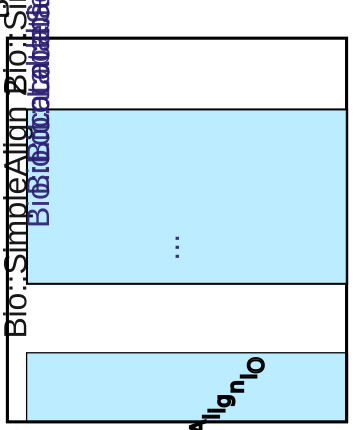
so let me descript how a Bio::AlignIO object formed.
Bio::AlignIO object can contain multiple alignments.
Bio::SimpleAlign contains one alignment.
Bio::LocatableSeq contains one aligned sequence.
For example, let's presume I have a file containing COI alignment for ten samples. If I use this file to call Bio::AlignIO->new(), the new Bio::AlignIO object will contain only one Bio::SimpleAlign object which contains this COI alignment. Then, the Bio::SimpleAlign object contains ten Bio::LocatableSeq objects for aligned COI sequences of each sample.
one alignment is tranditional one gene or multiple genes alignment, e.g., a COI alignment in here. Usually this type of alignment data is stored one file like phylip, nexus or fasta. but Bio::AlignIO
can manage blast output, too. so Authors keep the ability of contain multiple alignments in one Bio::AlignIO object. In my condition, I just directly get first Bio::SimpleAlign from it.
Today I just wanted to retrieve the sequences of each sample in my alignment file (fasta) and import them into Perl. To achieve this, first, we need to call the new method to create a new Bio::AlignIO object, using the alignment file as an argument:
my $in = Bio::AlignIO->new(
       -file   => $inputfilename,
       -format => 'fasta',
     );
Then, we want to extract Bio::SimpleAlign objects from the Bio::AlignIO object. For convenience, we use the same method as described in the Bio::AlignIO documentation. We use a while loop to iterate through each Bio::SimpleAlign object contained in the Bio::AlignIO object (although we know there is only one):
while ( my $aln = $in->next_aln() ) { ... ;}
Now, we need to extract Bio::LocatableSeq objects from Bio::SimpleAlign. Calling the each_seq() method of Bio::SimpleAlign allows us to retrieve Bio::LocatableSeq objects, each storing a sequence:
foreach my $seq ($aln->each_seq) { ...; }
At this point, we're nearly done. Simply by calling the seq() and id() methods of Bio::LocatableSeq objects, we can obtain the sequence ID and the actual sequence data. For instance, to print out the base pairs of each sequence:
foreach my $seq ($aln->each_seq) {print $seq->seq(), "\n"}
References:
]]>In absence of many other pressing issues, we spent some time thinking ahead to large-scale development work that might take place in the 5.41 series. We talked about “hooks” as a potential long-term thought to making a more powerful Magic-like structure, for implementing new features, attributes, etc..
]]>Spoiler Alert: This weekly challenge deadline is due in a couple of days from now (on March 3, 2024 at 23:59). This blog post provides some solutions to this challenge. Please don’t read on if you intend to complete the challenge on your own.
You are given an array of integers, @int and an integer $k.
Write a script to find the sum of values whose index binary representation has exactly $k number of 1-bit set.
Example 1
Input: @ints = (2, 5, 9, 11, 3), $k = 1
Output: 17

Binary representation of index 0 = 0
Binary representation of index 1 = 1
Binary representation of index 2 = 10
Binary representation of index 3 = 11
Binary representation of index 4 = 100

So the indices 1, 2 and 4 have total one 1-bit sets.
Therefore the sum, $ints[1] + $ints[2] + $ints[4] = 17
Example 2
Input: @ints = (2, 5, 9, 11, 3), $k = 2
Output: 11
Example 3
Input: @ints = (2, 5, 9, 11, 3), $k = 0
Output: 2
Although it could easily be done in a one-liner, I've decided to split the solution in two statements, for the sake of clarity. The first statement finds the indexes whose binary representation contains exactly $k "1" (sum of digits equal to $k) and populates the @eligibles array with the corresponding input values in @in. The second statement simply returns the sum oh those values.
sub sum-of-values ($k, @in) {
    my @eligibles = map { @in[$_] },
        grep {$_.base(2).comb.sum == $k}, 0..@in.end;
    return @eligibles.sum;
}

my @tests = (1, <2 5 9 11 3>),
            (2, <2 5 9 11 3>),
            (0, <2 5 9 11 3>);

for @tests -> @test {
    printf "%-15s => ", "@test[]";
    say sum-of-values @test[0], @test[1];
}
This program displays the following output:
$ raku ./sum-of-values.raku
1 2 5 9 11 3    => 17
2 2 5 9 11 3    => 11
0 2 5 9 11 3    => 2
This is a port to Perl of the above Raku program. I counted the number of "1" using the tr/// operator because has no built-in sum function, only to find moments later that I needed to implement a sum subroutine anyway.
use strict;
use warnings;
use feature 'say';

sub sum {
    my $sum = 0;
    $sum += $_ for @_;
    return $sum;
}

sub sum_of_values {
    my ($k, @in) = @_;
    my @eligibles = map { $in[$_] }
        grep {sprintf ("%b", $_) =~ tr/1/1/  == $k} 0..$#in;
    return sum @eligibles;
}

my @tests = ( [1, [<2 5 9 11 3>]],
              [2, [<2 5 9 11 3>]],
              [0, [<2 5 9 11 3>]] );

for my $test (@tests) {
    printf "%-3s - %-15s  => ", "$test->[0]", "@{$test->[1]}";
    say sum_of_values $test->[0], @{$test->[1]};
}
This program displays the following output:
$ perl ./sum-of-values.pl
1   - 2 5 9 11 3       => 17
2   - 2 5 9 11 3       => 11
0   - 2 5 9 11 3       => 2
The next week Perl Weekly Challenge will start soon. If you want to participate in this challenge, please check https://perlweeklychallenge.org/ and make sure you answer the challenge before 23:59 BST (British summer time) on March 10, 2024. And, please, also spread the word about the Perl Weekly Challenge if you can.
]]>Further chats on allowing a subsequent use VERSION of the same value as is already prevailing
We continued going through the bug list to tag release blockers
Spoiler Alert: This weekly challenge deadline is due in a few days from now (on March 3, 2024 at 23:59). This blog post provides some solutions to this challenge. Please don’t read on if you intend to complete the challenge on your own.
You are given a array of positive integers, @ints.
Write a script to find out how many integers have even number of digits.
Example 1
Input: @ints = (10, 1, 111, 24, 1000)
Output: 3

There are 3 integers having even digits i.e. 10, 24 and 1000.
Example 2
Input: @ints = (111, 1, 11111)
Output: 0
Example 3
Input: @ints = (2, 8, 1024, 256)
Output: 1
We use the chars function to count the characters of each integer, grep with the % modulo oprator to filter the counts that are even, and finally the elemsmethod to count the integers satisfying the desired condition. Altogether, a nice little oner-liner.
sub count-even-digits-ints (@in) {
    (grep { .chars %% 2 }, @in).elems;
}

my @tests = <10 1 111 24 1000>, <111 1 11111>, <2 8 1024 256>;
for @tests -> @test {
    printf "%-20s => ", "@test[]";
    say count-even-digits-ints @test;
}
This program displays the following output:
$ raku ./count-even-digits.raku
10 1 111 24 1000     => 3
111 1 11111          => 0
2 8 1024 256         => 1
This is a port to Perl of the above Raku program, using scalar and length to replace elems and chars. Also a concise one-liner.
use strict;
use warnings;
use feature 'say';

sub count_even_digits_ints {
    scalar grep { ! (length($_) % 2) } @_;
}

my @tests = ( [<10 1 111 24 1000>],
              [<111 1 11111>], [<2 8 1024 256>] );
for my $test (@tests) {
    printf "%-20s => ", "@$test";
    say count_even_digits_ints @$test;
}
This program displays the following output:
$ perl ./count-even-digits.pl
10 1 111 24 1000     => 3
111 1 11111          => 0
2 8 1024 256         => 1
Again, a port of the two previous programs to Julia. The only significant difference is that we need to explicitly convert integers to strings to be able to find their length (number of characters).
using Printf

function count_even_digits_ints(invals)
    evens = filter(x -> (mod(length(string(x)), 2 ) == 0), invals)
    return size(evens, 1)
end

tests = [ [100, 1, 111, 424, 1000],
          [111, 1, 11111], [2, 8, 1024, 256] ]

for test in tests
    @printf "%-25s => " "$test"
    println("$(count_even_digits_ints(test))")
end
This program displays the following output:
$ julia  count-even-digits.jl
[100, 1, 111, 424, 1000]  => 1
[111, 1, 11111]           => 0
[2, 8, 1024, 256]         => 1
The next week Perl Weekly Challenge will start soon. If you want to participate in this challenge, please check https://perlweeklychallenge.org/ and make sure you answer the challenge before 23:59 BST (British summer time) on March 10, 2024. And, please, also spread the word about the Perl Weekly Challenge if you can.
]]>click here to submit your abstract
You may submit your Science Track abstracts here! Don't wait, do this today! Prior registration to the Perl Conference is not a condition for acceptance, however individuals with accepted papers and posters are expected to register for and attend the Conference in person*. You may register for the Perl & Raku Conference here. (Note: in the past, the Conference registration fee has been waived for speakers; it is expected that this will be the case again this year, but at this time there are no guarantees.)
Deadlines:
When preparing your abstract, please bear in mind that the Science Perl Editorial Review Subcommittee is comprised of community members with a very wide range of scientific backgrounds, and any of them may be assigned to review your abstract and subsequent papers. When describing the goals of your paper, as well as the tools and approaches you use, write your abstract in such a way that it is informative to people working in the same or related fields, and understandable to a scientifically literate lay reader.
For more info, contact: science AT perlcommunity DOT org
Main conference site and registration links are at https://tprc.us/tprc-2024-las/.
]]>Warning: I wrote the program below and this blog post from an hospital bed in a heart intensive care unit. I think my mind is clear, but there may very well be a better way to solve the task. Also, I do not have the energy to port this Raku program to other languages, nor to provide lengthy explanations.
Given a matrix M, check whether the matrix is in reduced row echelon form.
A matrix must have the following properties to be in reduced row echelon form:
1. If a row does not consist entirely of zeros, then the first
   nonzero number in the row is a 1. We call this the leading 1.
2. If there are any rows that consist entirely of zeros, then
   they are grouped together at the bottom of the matrix.
3. In any two successive rows that do not consist entirely of zeros,
   the leading 1 in the lower row occurs farther to the right than
   the leading 1 in the higher row.
4. Each column that contains a leading 1 has zeros everywhere else
   in that column.
For example:
[
   [1,0,0,1],
   [0,1,0,2],
   [0,0,1,3]
]
The above matrix is in reduced row echelon form since the first nonzero number in each row is a 1, leading 1s in each successive row are farther to the right, and above and below each leading 1 there are only zeros.
*For more information check out this wikipedia article.
Example 1
Input: $M = [
              [1, 1, 0],
              [0, 1, 0],
              [0, 0, 0]
            ]
Output: 0
Example 2
Input: $M = [
              [0, 1,-2, 0, 1],
              [0, 0, 0, 1, 3],
              [0, 0, 0, 0, 0],
              [0, 0, 0, 0, 0]
            ]
Output: 1
Example 3
Input: $M = [
              [1, 0, 0, 4],
              [0, 1, 0, 7],
              [0, 0, 1,-1]
            ]
Output: 1
Example 4
Input: $M = [
              [0, 1,-2, 0, 1],
              [0, 0, 0, 0, 0],
              [0, 0, 0, 1, 3],
              [0, 0, 0, 0, 0]
            ]
Output: 0
Example 5
Input: $M = [
              [0, 1, 0],
              [1, 0, 0],
              [0, 0, 0]
            ]
Output: 0
Example 6
Input: $M = [
              [4, 0, 0, 0],
              [0, 1, 0, 7],
              [0, 0, 1,-1]
            ]
Output: 0
sub is-first-echelon (@mat) {
    my @leading;
    for 0..@mat.end -> $i {
        my @row = |@mat[$i];
        for 0..@row.end -> $j {
            next if @row[$j] == 0;
            if @row[$j] == 1 {
                @leading[$i] = $j;
                last;
            } else {
            }
        }
        @leading[$i] = Inf unless defined @leading[$i];
    }
    return False unless [<] grep { $_ < Inf }, @leading; # rules 2 and 3
    return False unless [<=] @leading;
    for 0..@leading.end -> $i {
        last if @leading[$i] == Inf;
        next unless defined @leading[$i];
        for 0..@mat.end -> $k {
            next if $i == @leading[$k];
            return False if @mat[$k][$i] != 0;
        }
    }
    return True;
}

my @tests =
    [ [1,0,0,1], [0,1,0,2], [0,0,1,3]],
    [ [1, 1, 0], [0, 1, 0], [0, 0, 0]],
    [ [0, 1,-2, 0, 1], [0, 0, 0, 1, 3], [0, 0, 0, 0, 0], [0, 0, 0, 0, 0]],
    [ [1, 0, 0, 4], [0, 1, 0, 7], [0, 0, 1,-1]],
    [ [0, 1,-2, 0, 1], [0, 0, 0, 0, 0], [0, 0, 0, 1, 3], [0, 0, 0, 0, 0]],
    [ [0, 1, 0], [1, 0, 0], [0, 0, 0]],
    [ [4, 0, 0, 0], [0, 1, 0, 7], [0, 0, 1,-1]];

for @tests -> @test {
    printf "%-20s => ", "@test[0] ...";
    say is-first-echelon @test;
}
This program displays the following output:
$ raku ./first-echelon.raku
1 0 0 1 ...          => True
1 1 0 ...            => False
0 1 -2 0 1 ...       => True
1 0 0 4 ...          => True
0 1 -2 0 1 ...       => False
0 1 0 ...            => False
4 0 0 0 ...          => False
The next week Perl Weekly Challenge will start soon. If you want to participate in this challenge, please check https://perlweeklychallenge.org/ and make sure you answer the challenge before 23:59 BST (British summer time) on March 3, 2024. And, please, also spread the word about the Perl Weekly Challenge if you can.
]]>A few people asked me about the distinctions between YAPC::Japan and other Perl events worldwide, prompting me to write below. Before delving into the specifics, I must preface that my experience is primarily rooted in YAPC::Hiroshima 2024, the only YAPC::Japan event I attended. It's important to say that comparing Perl events across different regions isn't about establishing superiority or inferiority; organizing conferences requires considerable resources and effort irrespective of location. Each conference has its unique approach and metrics for success. The observations I offer are purely subjective and reflect my personal views.
Size
Name
Donations
Structure
Volunteers
Minute-by-minute schedule
Sponsorship
Ticket pricing
Demographics
Alcohol
Post-event "YAYAPC" (Yet Another YAPC)
Other