The Perl Toolchain Summit (previously known as the Perl QA Hackathon) is an annual coding workshop for people involved in the Perl toolchain, testing, quality assurance, and related issues. I was glad to be invited to this one, my fourth.
The Perl Toolchain Summit (previously known as the Perl QA Hackathon) is an annual coding workshop for people involved in the Perl toolchain, testing, quality assurance, and related issues. 2018 marked ten years of the PTS, so it seems fitting that it returned to Oslo, where it was first held. I’ve attended a few of them, and I was very pleased to take part in this one as well.
As many people know by now, Ricardo Signes recently announced that he
will be standing down as pumpking once Perl 5.24.0 is released, after
four and a half years in the role — not to mention an unprecedented five
stable 5.x.0 releases of Perl!
Since the Perl QA Hackathon is the first Perl event Rik has attended
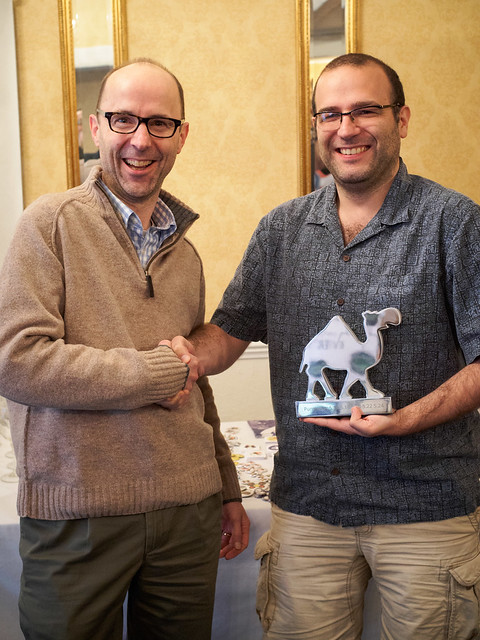
since his announcement, we thought it would be fitting to offer Rik a token
of our appreciation for the remarkable and tireless work he’s put in during
his service. So we closed up the second day of the hackathon with a short
presentation and a small expression of our gratitude (and hopefully one that
Rik didn’t find too embarrassing!)
In particular, Rik has now joined the very select group of people who’ve
received a Silver Camel.
I write this from sunny Rugby, England, where I’m attending the QA Hackathon 2016. It’s always great to spend time with people who are active in the Perl community, not just socialising, but working on the software we all depend on.
Cross-posted from my other blog.
Yesterday I had the pleasure of releasing version 5.17.8 of Perl.
Perl has had regular, time-boxed monthly development releases for about
three years now. This great improvement on the previous situation has been
accomplished partly by making the release process into something that can be
done even by people who, like me, are far from being experts in Perl’s
internals.
One of Perl’s long-standing traditions is that release announcements are
accompanied by an epigraph, chosen by the release victim volunteer.
Here are some notes about the epigraph I picked for 5.17.8.
 I blog about Perl.