Masters of Destiny
Doomed
It is an unfortunate fact of life reflected in the stages of man, that we start off facing problems looking to others to solve these problems. Later we learn to solve these problems ourselves, we teach others to do the same. After that we delegate problem solving to those we have taught but find that as our own capacity diminishes, those that come after us simply ask an AI to do that which we struggled to learn in the past. A steady spiral ensuring future humanity’s cognitive decline, fuelled by the genius of its ancestors. We had become masters of our destiny only to hand it over to machines, because we hope machines will do it better. Perhaps they will.
In my job, tools that were created to make our job easier demand data from us, enforce protocols and are the exclusive conduit for information. Thus in our so called “caring profession”, the modern doctor spends as much time staring at a monitor as looking at patients, more hands on keyboard than hands-on examination, relying more on scans than an unreliable clinical acumen. Indeed this future may be safer and it is foolish to value old system of compassionate care delivery just because dispassionate algorithms have dispensed with the need for a human touch.
Clouded Judgement
Enter one of my newest colleagues; let’s call him Waq. A gentle giant of a youth, who looked like he could beat you to a pulp with a cheerful handshake. This big-brained surgeon whose head was always in the clouds, had discovered LLMs residing in those clouds and wished to bring them to the reach of the lesser mortals such as myself.
“I know what you need!” he announced. Of course I knew exactly what I needed, and it didn’t involve a smart-alec youth (even if he is 8 feet tall, with arms the size of my thighs) telling me.
“Oh, hello Waq”, I said putting on my well-practised fake sincerity, “I was just hoping you would come along and tell me.”
Waq didn’t need any encouragement, seeming to derive an unending supply of enthusiasm from the ether, “You need A Cloud”.
“Goodness, you’re right!” I said, “A Cloud, you say? Lenticular or Cumulonimbus do you think?”
“You know how you hate AI and think it will take our jobs, end the world and so on?”
“I have seen Terminator, Waq”, I said “Of course I know what’s coming.”, with visions of Waq revealing himself as a cyborg with living biomimetic skin grown over a metallic endoskeleton.
“A Two-Way Interface for a Dynamic Digital Learning Experience and Deterministic Encoding of Expertise”, he declared. “Now this will use experts to encoding their knowledge, experience and available evidence in a form that be used to train other individuals, rather than rely on some dependency inducing neural network on a server somewhere.”
TWIDDLE-DEE? Twiddle dumb, I thought. But this was going way over my simpleton head, “Ah…and how is this better than, I don’t know, something archaic, say a textbook?”
Waq’s face clouded over, “Well it will have a Cloud, be Digital, Dynamic, and Deterministic.”
“Did you ask ChatGPT to come up with this?”
Waq realised how easily he had fallen fell into the trap created by an AI that was not above subterfuge in the guise of being helpful.
“It’s ok, Waq.”, I consoled him, “This is exactly why you should watch 80s Sci-Fi on VHS tapes instead of adding to the training dataset of those silicon cybernetic systems planning to take over the world.”
“It’s too late, isn’t it?”
I would have patted him on his shoulder if I could have reached it. But an idea struck me. There is another kind of cloud that could be useful. “The future is not set, Waq”, I said, “You’ll be back.”
Interactive Word Cloud
Examples of Word Cloud Generators abound on-line. While useful for one off projects, for flexible and easily configurable it is handy to have a module for your own language of choice. MetaCPAN has a couple of options. c0bra(Brian Hann) created Image::WordCloud to generate raster Word Cloud Images. It is rather clever, depends on SDL to determine the dimensions of a word to create a attractive word cloud. Sarah Roberts created HTML::TagCloud to generate HTML Tags.
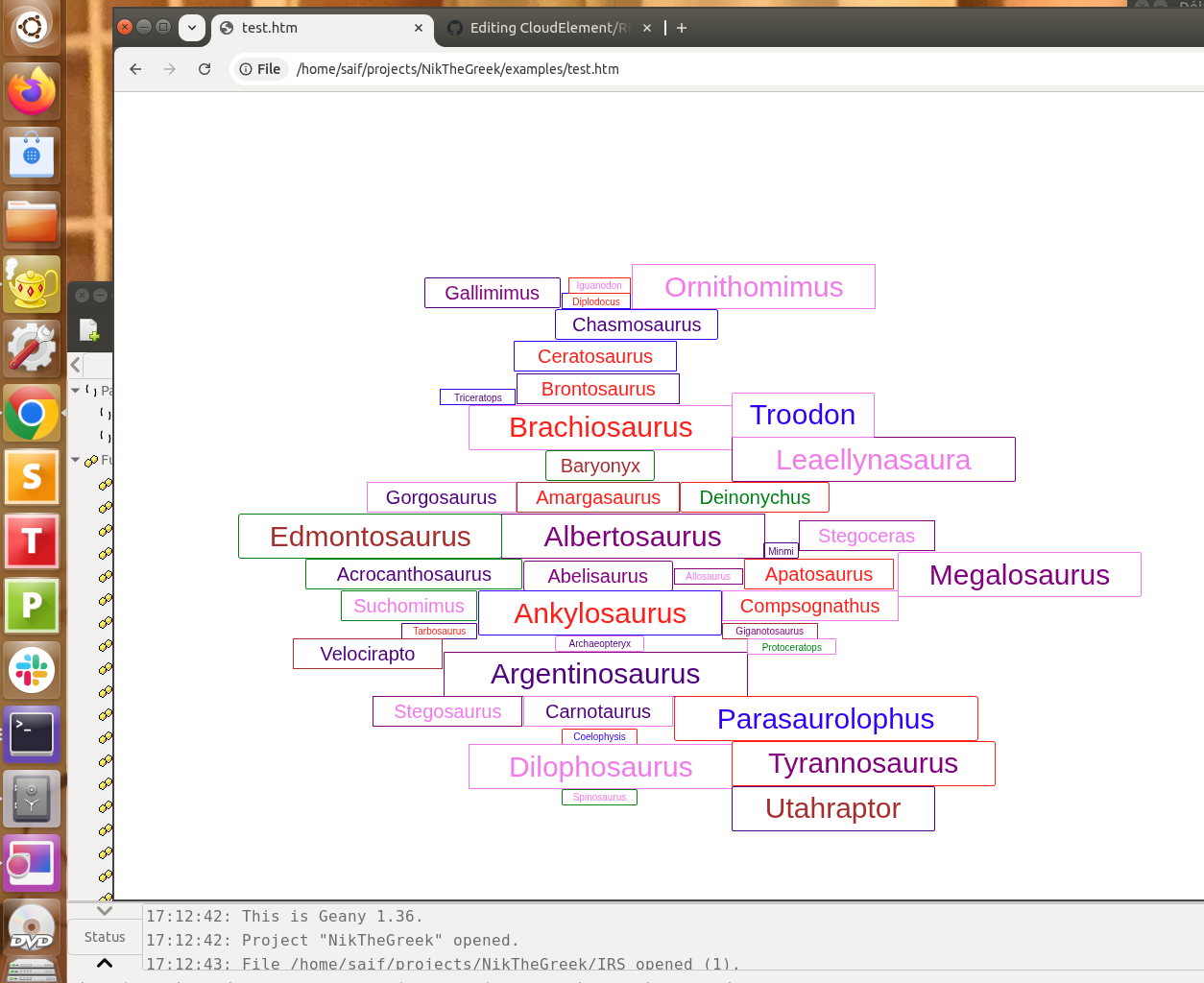
I am developing yet another option, this time using addressable elements to generate Word Clouds in svg and html. This potentially allows dynamic manipulation and interaction with the cloud. One possible goal is to develop a deterministic tree connecting multiple such word clouds as part of an expert system.
My early effort is CloudElement
 An Orthopaedic Surgeon, A Tissue Engineering Scientist, Lecturer, (and Hobbyist Programmer, Electronics Engineer and Roboticist)

Leave a comment