
Ivan Bessarabov
- Website: ivan.bessarabov.ru
Recent Actions
-
Commented on Mood Lighting
I highly recommend you to try using https://www.home-assistant.io — it is an awesome system for home automation....
-
Commented on New Perl project. Interactive Perl coding tasks to run in the browser
> I feel if a problem is added from web form, and answers are also added from web form, it will become interactive communication by a teacher and students. I agree. Creating a file in some format on GitHub is...
-
Commented on New Perl project. Interactive Perl coding tasks to run in the browser
> But THANK YOU! Now I can stop using perl -e at the command line for short snippets that invarialbly become programming sessions! Oh, Thank you! I'm always very happy to hear that this small project is useful not only...
-
Commented on New Perl project. Interactive Perl coding tasks to run in the browser
> Suggest this change: > ... See the PerlBanjo link above for errors. Thank you for you suggestion! I'm sorry, but I'm not sure this is the text I'm looking for. For example the FooBar problem. There can be no...
-
Commented on New Perl project. Interactive Perl coding tasks to run in the browser
I'm sorry, but I'm not sure that I understood your question that correctly. After registration you can submit solution to the problems via web interface https://upload.bessarabov.ru/bessarabov/mCSAHUt20oRzjS_Bhj6apdFrXoA.png?a If you are asking about the interface to add new problems to the system,...
-
Commented on New Perl project. Interactive Perl coding tasks to run in the browser
Thank you! I'm made two changes on the site. 1. I haven't thought about such simple improvements of textarea. I've added all that attributes to the site, so the textarea should work a bit better. 2. I agree that when...
-
Commented on New Perl project. Interactive Perl coding tasks to run in the browser
Thank you! I think that I have fixed all "Interactive" on all the places on the site....
-
Posted New Perl project. Interactive Perl coding tasks to run in the browser to Ivan Bessarabov
Some time ago I have created a small web project about Perl programming language. The site where you can execute Perl code online — PerlBanjo.com. (
-
Commented on Tabs vs Spaces. Article about symbols that are used for indentation in 3.8 million Perl files on CPAN
I'm not too very surprised that the mixed spaces & tabs are the most popular choise. But I'm very surprised that the share of mixed tabs spaces is constantly decreasing. I would like to know why is that....
-
Posted Tabs vs Spaces. Article about symbols that are used for indentation in 3.8 million Perl files on CPAN to Ivan Bessarabov
There are 135 thousand releases on CPAN now. In those releases there are about 3.8 million files with extensions .pm, .pl, .t or .pod.
Here is a link with a small research what symbols are used for indentation in all that files.
There is obvious trend, but unfortunately in this ar…
-
Posted 309 ways to do $A++ in Perl to Ivan Bessarabov
Here is a list of 309 code examples how to increment variable in Perl.
I think that is it very funny, creative and awful at the same time.
As far as I can see, not all code examples are working and not every one is interesting, but some of the solutions are truly magical.
…
-
Commented on Site perlbanjo.com is released! Run & share Perl code in the browser.
This system was created with security in mind. Every run is performed in the isolated limited sandbox that is created especially for the run and is destroyed afterwards. It is harmless that you can access file /etc/passwd There are no...
-
Commented on Site perlbanjo.com is released! Run & share Perl code in the browser.
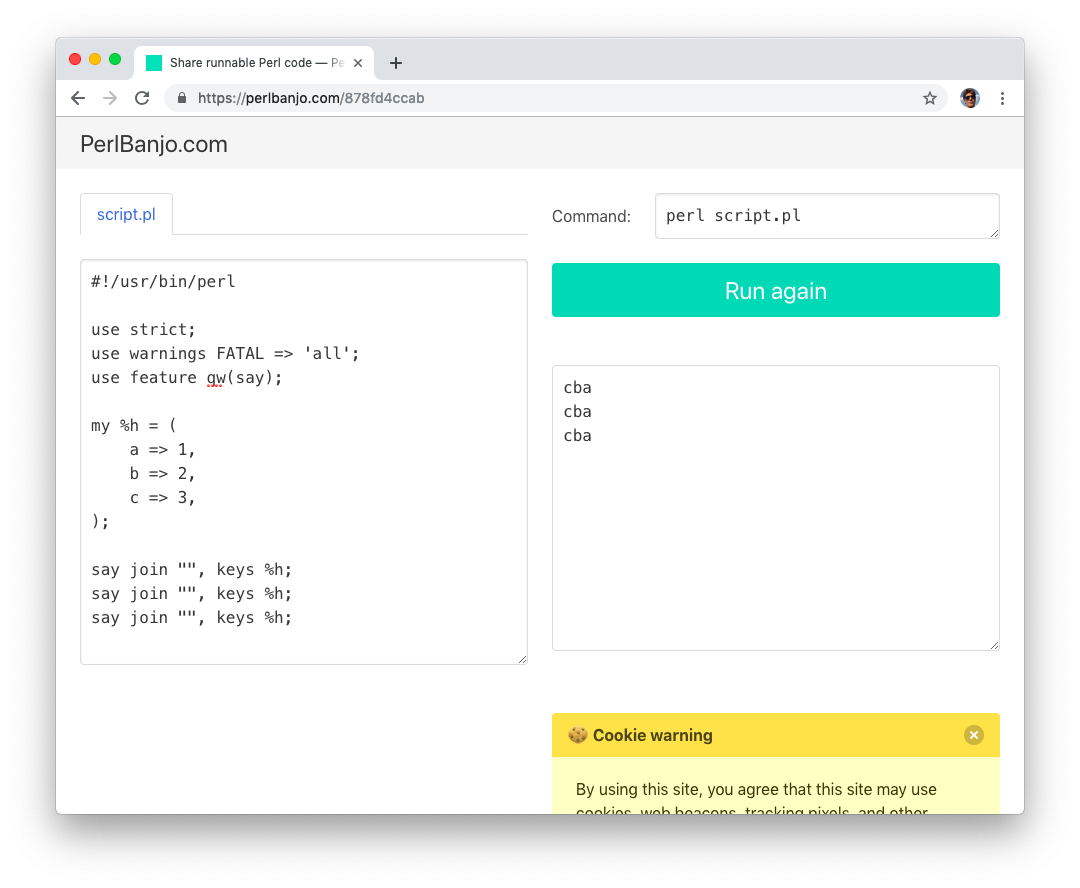
I like this idea! Thank you. I've updated the site and added the version badge near the result: Here is the runnable code: https://perlbanjo.com/4ad573b495 (and here is a screenshot: https://upload.bessarabov.ru/bessarabov/MqYNgDa82oe4pM_oCPbhA6SW_ig.png )...
- Posted Site perlbanjo.com is released! Run & share Perl code in the browser. to Ivan Bessarabov
-
Posted Using Perl Dancer and Docker to create simple monitoring system to Ivan Bessarabov
I needed a simple system to monitor events. I wanted to have a system where system to be able to expire statuses. In case there is no data for the object for a long time then the status should be automaticly changed to 'u…
-
Commented on Making git bisect more useful
Thank your for the post! I was using git bisect (and some time ago I was using svn bisect — https://metacpan.org/release/App-SVN-Bisect) But after I have started using Jenkins for private project and Travis for open source project I have never...
-
Commented on My Favourite Test::* Modules
Thank you very much for the module Test::LongString! This is exactly what I needed (and before finding it I haven't understood that I need it =)....
-
Commented on blogs.perl.org and https
ugexe, yes this is what i do =) I'm sure that in the modern world evey site should use https, so lets make blogs.perl.org a bit better place — it is easy =)...
-
Posted blogs.perl.org and https to Ivan Bessarabov
I'm living in Moscow, Russian. Here we have Underground, a rapid transit system. Recently there appeared free WiFi. You just need to connect some WiFi spot, then accept the Licence agreement and you can use Internet.
Yesterday I've opened blogs.perl.org at my mobile phone and here is what …
-
Commented on pause.cpan.org is not working. Does somebody know something?
I like "CPAN Once a Week" contest =) Are there any details about it?...
-
Commented on pause.cpan.org is not working. Does somebody know something?
Thank you, Neil. After your link everything is clear....
-
Posted pause.cpan.org is not working. Does somebody know something? to Ivan Bessarabov
Yesterday I wanted to upload d new release to CPAN, but I could not do it because http://pause.cpan.org/ is down.
This site is still down.
There are several posts on twitter, so it is just me:
-
Commented on The beauty of CSV
This is very interesting idea, thank you! When I work with CSV I always meet the same problem. There is no strict standard for CSV and CSV stadard differ a lot. Sometimes there is "\n" for new lines and sometimes...
-
Commented on Test::Whitespaces
@confuseAcat, I want to thank you again for your bug report. =) Today I have released new version of Test::Whitespaces 1.0.0 that output all errors not only when started with `prove -v`, but also when you run `prove` without `-v`....
-
Commented on Test::Whitespaces
> There is also Test::NoTabs and Test::Tabs (mine) on CPAN. Great! Thank you! There was link to Test::NoTabs in the "SEE ALSO" section, I've added link to your module Test::Tabs https://github.com/bessarabov/Test-Whitespaces/commit/d40d2eb0acf0f68994a3a7f06cc2cde4a99c19c3...
-
Commented on Test::Whitespaces
> Running the test script from the synopsis using prove doesn't output anything helpful Thank you for finding this issue! You will certainly see information about errors if you run `prove -v t/Whitespace.t`. I'm not sure if there should be...
-
Commented on Test::Whitespaces
> It doesn't check for code formatting, but Test::EOL and Dist::Zilla::Plugin::EOLTests checks for trailing whitespaces and for tabs. Thank you Ether. Yes, Test::Whitespaces works on the same problem as Test::EOL. And Test::EOL is in the "SEE ALSO" section of Test::Whitespaces...
-
Commented on Test::Whitespaces
> Isn't Perl::Tidy a better choice for this? You can also make Perl::Critic check the tidiness... Yes, you are 100% correct. Perl::Tidy and Perl::Critic can solve some whitespaces errors. Test::Whitespaces has this advantages: Test::Whitespaces is much easier than Perl:Tidy and...
-
Posted Test::Whitespaces to Ivan Bessarabov
Perl is very flexible in may ways including whitespaces. Perl does not force you to use tab or spaces. The script works fine no matter if it has DOS or UNIX line breaks.
But there are some good practices. I preffer these rules:
- every line ends with "\n" (including the last li…
-
Commented on Perl Calltrace
Or lib::abs http://search.cpan.org/perldoc?lib::abs...
 Recent Actions from Ivan Bessarabov
Comment Threads
-
byterock commented on
Tabs vs Spaces. Article about symbols that are used for indentation in 3.8 million Perl files on CPAN
IMHO the bloger would of better off spending his time doing a few pull requests and fixing some bugs then spending a bunch of time exaiming the ages old 'tab' vs 'space' debate.
Since the days PC computers got more than 640K of disk space on a floppy it has stopped to be an issue.
In the good old days of 64k many of old farts would argue for 'tabs' as the took only 8 bits of less memory than while '4 spaces' took up 32.
In the big scope of things it really doesn't matter much
-
Yuki Kimoto commented on
New Perl project. Interactive Perl coding tasks to run in the browser
This is fun Perl quiz!
I registered and login it now.
Can I register my Perl problem from Web Interface?
-
Matthew Persico commented on
New Perl project. Interactive Perl coding tasks to run in the browser
Suggest this change:
The solution that you have entered does not work as expected. See the PerlBanjo link above for errors.
-
Matthew Persico commented on
New Perl project. Interactive Perl coding tasks to run in the browser
But THANK YOU! Now I can stop using perl -e at the command line for short snippets that invarialbly become programming sessions!
-
Yuki Kimoto commented on
New Perl project. Interactive Perl coding tasks to run in the browser
thank you.
>If you are asking about the interface to add new problems to the system, there is no such interface.
I understand current SquarePerl.com features now.
I feel if a problem is added from web form, and answers are also added from web form, it will become interactive communication by a teacher and students.
Responses to Comments from Ivan Bessarabov
About blogs.perl.org
blogs.perl.org is a common blogging platform for the Perl community. Written in Perl with a graphic design donated by Six Apart, Ltd.
