Just when I though I had all the bugs out of my Database::Accessor I found a bunch more while finishing off tests case '42_new_validation.t'.
Most of the bugs where with the 'links' attribute. My test for this attribute are a check to make sure a link has a 'to' is present, and it not undef, and the same for type and then at lease on condition is present.
The first bug was
not ok 19 - type is proper link ; links
and the error it was throwing was;
'links->type' Constraint: The Link 'undef', is not a valid Accessor Link! Try one of 'LEFT', 'OUTER', 'RIGHT'
Final day... and the RPerl live demo works! We can show how fast the compiler runs, and some people even asked if it’s for real. It is! Will and Mahrez did a great job, but they didn’t stop there; RPM installation packages are now available for programmers to try RPerl on their own code. CentOS 7 is currently supported, with more RedHat and Debian operating systems coming up next.
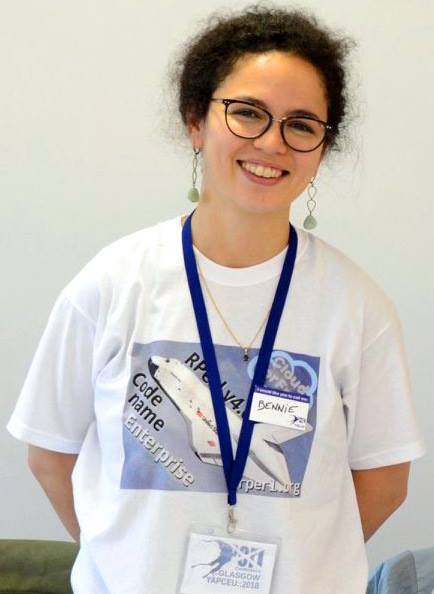
RPerl is an open source project, meant to benefit the whole community, and even if I don’t really get it, I’m very proud to promote that. I am not a computer programmer myself,
but I am happy to call myself a "Friend of Perl" and also a "Friend of RPerl". You can, too!
I had the great pleasure of talking to Gloria Wall on that last day, after the brilliant interview she gave on day 2. (For those who don't already know, Gloria is the wife of Perl founder Larry Wall.) She told me that not being a programmer doesn’t mean I don’t belong here. Everyone should feel welcome to join in, and bring whoever is interested. I’ll remember that conversation as one of the highlights of this conference. I’m very happy to have been part of it, and I can’t wait until the next one!
We’ve been missing a Log4perl plugin for Dancer2 for, well, forever, and this weekend I have released Dancer2::Logger::Log4perl.
This was originally developed by Ryan Larscheidt and Jon Miner at the University of Wisconsin. I have added a minimal test, a little pod, and wrapped a release around it. The rest of this is their work, and I cannot thank them enough for making this happen. Special thanks goes out to Mohammad S Anwar for finding some omissions from my original release earlier this weekend.
There are more tests needed still, but I wanted to get this out in the wild as soon as I could.
If you notice any issues, please report them at https://github.com/cromedome/Dancer2-Logger-Log4perl/issues
Now that I have my constructor single error working the way I like I figure I better go back and clean up my test cases and create a new test case just to check the error on 'new' construction.
I am going to start with '30_view.t' as that is the one I have been mucking with most over the past little while.
The first thing I did was strip out the new 'validation' tests and suck them in a new tests case '42_new_validation.t' and after a few adjustments it presently looks like this;
After a round of code review the js branch has been merged into master.
The nqp part has been on master for a long time so the whole js backend is now merged
In other good news 6pad is up (https://perl6.github.io/6pad/).
6pad allows you to compile and run Perl 6 code from the comforts of your own browser.
For now Rakudo.js depends on BigInt support (which mean you should likely use 6pad with Chrome).
BigInt support is being worked on Firefox and all the Chrome derivatives should update their V8s soon.
6pad is still being worked on so it still likely has some bug.
Support for using React to create DOM elements is planned and should come soon.
6pad has support for running your gists so if you write your own spiffy Perl 6 example I'll show it to 6pad users.
Focus of the JS backend will now be on on polishing 6pad and fixing some failing tests.
I (Zoffix Znet) am writing this document to Larry Wall to request the creation of a second name for the "Perl 6" language. This name is not a rename of the language, but is simply an alternative name, an alias. Similar to how TimToady is an alias for Larry Wall.
It's been a year and a half since the time when I first re-opened this issue with a blog post, and in this document, I compiled the argumentation for creation of the alias, the community suggestions for what that alias might look like, along with the observations of discussions on the topic that occured during that time period.
I ask that Larry Wall renders his decision on the alias by November 1, 2018, so we would have the time to create proper informational materials for the 6.d language release, during which time, the name alias would be officially announced, if one is chosen.
Developers team of the PVS-Studio static code analyzer for C/C++/C#/Java checked the Perl 5 source code and found some errors.
For example, the incorrect using of the ternary operator:
V502 Perhaps the '?:' operator works in a different way than it was expected. The '?:' operator has a lower priority than the '-' operator. toke.c 9494
I had only one little goal today and that is come up with a really nice single construction error message. After a good hour or so of mucking about I finally came up with;
I'm planning to remove the module Unicode::Properties from CPAN. The reason to remove the module is that it is outdated (the code is from 2008), the module uses a faulty methodology to get the properties, and it is unreasonable to maintain in its current form. Currently the module has no stars on metacpan, has no reviews or reverse dependencies, and the only user feedback I have received, from Tom Christiansen was to tell me that the module wasn't good enough for his purposes (see module doc), so I assume it is unused.
If you are a user of this module, please let me know. If you want to adopt the module (strongly not recommended) let me know.
For the October 9 gathering of Boston Perl Mongers we'll be hosted by MaxMind in Waltham, instead of our usual MIT location. Our speaker will be Mark Fowler.
(Boston.PM is happy to accept this offer of hosting from MaxMind, and would welcome hosting offers from other organizations in Eastern MA. It gives those who live further West or otherwise are unable/unwilling to travel to the city a chance to attend.
We're also looking for presenters. You don't have to travel to Boston. Remote presenters welcome. Have a module you want to promote, or a conference talk you'd like to "beta test" or give again, see our presenter's guide.)
About the talk:
A resource for beginners and advanced Perl users alike, the Perl Advent calendar features humorous stories featuring Santa's Elves and the fun they have with Perl. This talk will talk about all the exciting things that occurred in last year's calendar. Somewhat akin to twenty four two minute lighting talks, it'll expose you to a wide range of topics.
Today I am going to add in another attribute called 'all_errors' a simple Boolean flag so my end user can either get a single error message of all the errors found or the 'MooseX::Constructor::AllErrors' object with all the errors when using the 'new'. Simple enough I can just add it here
While reflecting on how to write a good Perl 6 module, I thought a lot about how to properly name my methods. In this text I want to summarize what served me, which is a direct continuation of the last part, where I wrote about when it is helpful that methods share one name.
The Hacktoberfest Challenge 2018 is on and it is my fourth attempt. As always, I am very excited about the event.
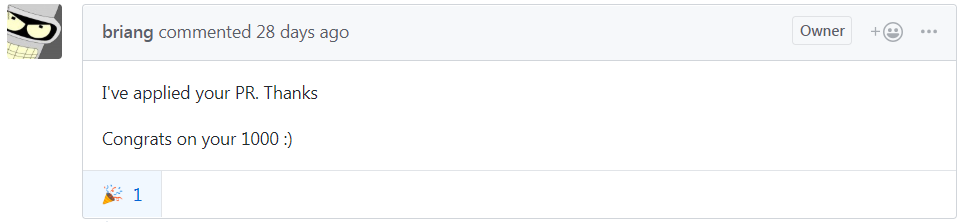
September 2018 has been very special month so far for me. Why? In this very month, I submitted my 1000th Pull Request. Also as of today 1st Oct 2018, I have completed 407th days of daily upload to CPAN. My next target is reach 500 days mark, which I am hoping to reach by new year. I also submitted my talk proposal to London Perl Workshop 2018. The title of my proposed talk is "The power of mentoring". For a change, I have also submitted proposal for lightning talk "What after the Pull Request Challenge?". If you haven't submitted your talk proposal yet, then please do so now. I would like to
share one sweet moment with everyone. After submitting my 1000th PR, the first PR that got merged after that had the following message for me.
Here’s a pattern which took me a while to figure out this past week, and therefore seemed worthy of sharing with you guys.
First, let’s set the situation. (These are certainly not the only conditions under which you could use this pattern, but it’ll probably be easier to grasp it with a concrete example.) Let’s say you have a script which you’re going to use to launch your other Perl scripts. This script (in my example, it’s a bash script, but it could also be a super-minimal Perl script) has exactly one job: set up the Perl environment for all your personal or company modules. That may even include pointing your $PATH at a different Perl (e.g. one installed via perlbrew or plenv) so you’re not reliant on the system Perl. Here’s a typical example of what such a (bash) script might look like:
I have been asked this question many times since I submitted over 1000 PR. Before I answer this question, I would like to share a secret with you all.
It all started in the month of Jan 2015 with Pull Request Challenge (PRC) pioneered by Neil Bowers. Although I was already submitting PR before that but without any target. With PRC, I got direction where to go. I must admit taking on PRC wasn't easy one. I didn't want to make a fool of myself by joining PRC and not submitting PR regularly. I still remember first couple of months, so many Perl hackers joining the PRC but not every one actually submit PR regularly. Some even dropped after a while. But I kept it going as I was enjoying it. Although I was hardly getting any acknowledgement from the distribution author. It can be discouraging for the beginners.