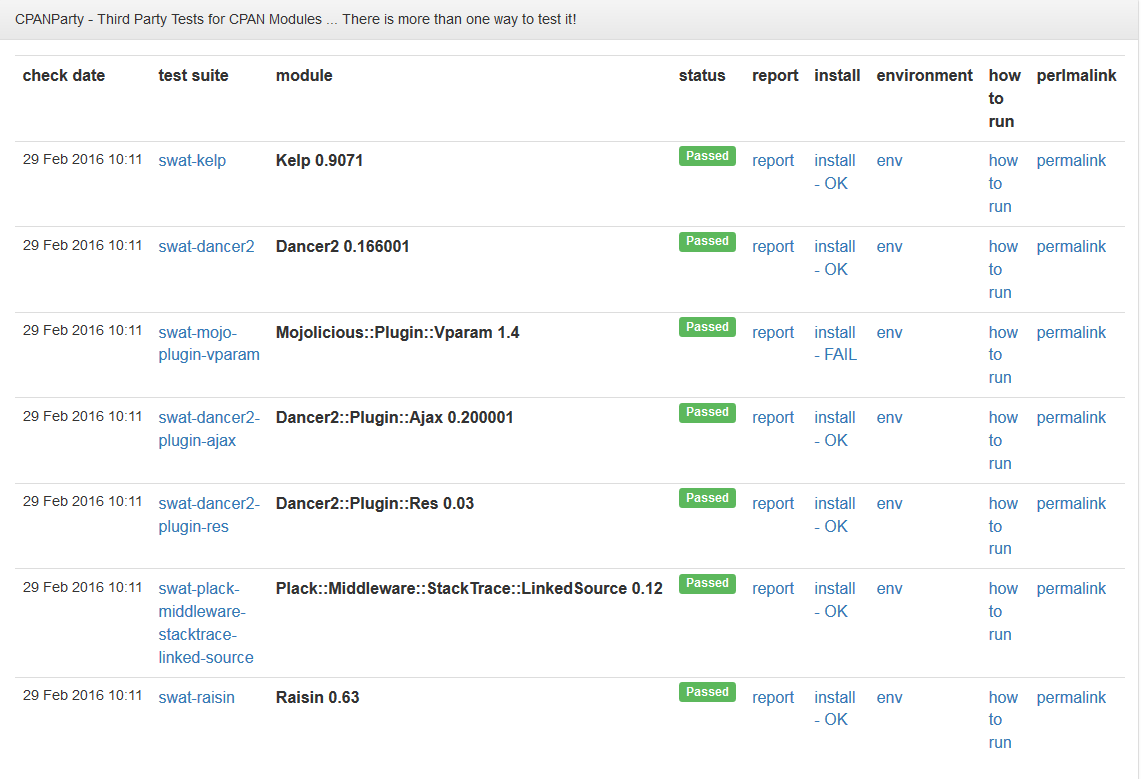
Not long time ago I asked a community about possible service to run integration tests for existed cpan modules , not having too much feedback I decided to run such a service to make my suggestion visible and available to try for other users.
So, meet CPANParty - an alternative integration tests for cpan modules. Right now service is hosted on swatpm site, but in the future I will probably move it to dedicated domain.
Only a few randomly chosen cpan modules was picked up and tested. Eventually I will add more.
On behalf of the Rakudo development team, I'm very happy to announce the
February 2016 release of Rakudo Perl 6 #96. Rakudo is an implementation of
Perl 6 on the Moar Virtual Machine
This release implements the 6.c version of the Perl 6 specifications.
It includes bugfixes and optimizations on top of
the 2015.12 release of Rakudo, but no new features.
Upcoming releases in 2016 will include new functionality that is not
part of the 6.c specification, available with a lexically scoped
pragma. Our goal is to insure that anything that is tested as part of the
6.c specification will continue to work unchanged. There may be incremental
spec releases this year as well.
Please note: This announcement is not for the Rakudo Star
distribution[^1] --- it's announcing a new release of the compiler
only. For the latest Rakudo Star release, see
http://rakudo.org/downloads/star/.
For the past year I’ve been working on putting a new business together that is built on top of Perl and AngularJS. The new business is called Tabletop.Events. It is a convention management platform for the hobby board game industry.
It’s features include:
Badge sales and printing
User event submissions
Event ticket sales
Registration desk management
Blog and email newsletter to attendees
Desktop and mobile friendly interfaces
A full web service API
It’s built on Wing, which is the same core toolkit we used to build The Game Crafter. On the back-end, Wing is pure Perl making use of Dancer, DBIx::Class, Moose, and a whole host of other Perl technologies. On the front-end Wing is all AngularJS, which allows us to rapidly build out a robust UI that automatically ties itself to the Perl backend.
If you want to learn more about the technologies used to make Tabletop.Events, come hang out with us at the next MadMongers meeting.
Last time I have been deeply involved into test automation development. So some projects was born like swat, outthentic and finally sparrowhub.
After some mediation on the future of my projects I am still committed to the idea of sharing such a tests with the rest of perl/cpan community.
An issues arise on my way though:
people used to stick to convenient unit tests kept under their cpan distributions and are half-heartedly for third party tests alternative which of course is respected by me.
(IMHO) integration tests are hard to write and maintain, this is probably why people prefer to write unit tests, and as swat is kind of integration test tool, it could be "neglected" for the reason above. I believe still that integration tests are essential part of development.
Taking into account all of this I am introducing an idea of third party tests service - 3Party ( working name, just can't invent something better right now ) with the following features:
Part 3 of the Regular Expressions to Grammars tutorial is now up at http://theperlfisher.blogspot.nl/2016/02/from-regular-expressions-to-grammars-pt_20.html - This covers parsing of a short JavaScript blurb into a form that the compiler we're going to write next time can understand.
At the beginning of the year I've sent out a call for authors. It took us a while, but I am happy to report that there are already 3 guest-post from 3 different authors.
Marpa for building parsers - a first look by Peter Jaquiery aka GrandFather on PerlMonks
How to install Perl modules on FreeBSD by Steve Dickinson
Benchmark: Refactoring MD5 calculation in Rex by Ferenc Erki, one of the core developers of Rex
I don't link directly to the articles as they are only available to Perl Maven Pro subscribers, but you can find them in the archive together with other 700+ articles.
Later, after a few month, these article will be made available to the general public free of charge.
If you would like to contribute to this growing body of knowledge about Perl while earning some money, then please get in touch with me via e-mail.
If you'd like to support the effort by giving money then subscribe to the Perl Maven Pro. The more subscribers there are, the more articles and authors I can pay for.
I released GitPrep 1.12. You can install portable GitHub system into Unix / Linux easily. It is second major release.
Because you can install GitPrep into your own server, you can create users and repositories without limit. You can use GitPrep freely because GitPrep is free software. You can also install GitPrep into shared rental server.
The thing that hath been, it is that which shall be; and that which is done is that which shall be done: and there is no new thing under the sun.
Is there any thing whereof it may be said, See, this is new? it hath been already of old time, which was before us.
(Ecclesiastes 1:9,10)
Outthentic is a tool for rapid plugin developments. When I say "plugin" I mean a little utility to solve a specific task.
Having a risk to reinvent the wheel, from time to time I still start to create some useful stuff, at least useful from my point of view ...
Disk usage monitoring
This little plugin does what is stated at the header:
checks disk space in partition by partition basis
alerts in case of shortage
a threshold parameter could be set and equal 80 default, which means before 80 percentage of disk usage we are ok.
It's halfway to CPAN Day 2016, so I'm going to be celebrating it as a mini-CPAN Day and using it as an opportunity to get some small releases out that otherwise might not justify a release on their own, like updating the distribution tooling or making documentation tweaks.
Thanks to our first grant from The Perl Foundation, we have released the first partial draft of the new book Learning RPerl, available on either CPAN or directly on the RPerl website:
Please take a moment to click the following link and leave a comment, this counts as your vote for RPerl to receive the next round of funding from The Perl Foundation:
Outthentic - is language to parse unstructured text.
It was grown as supporter for web application test tool named swat.
Web application is where text often comes in unstructured and unordered way, even though there is json and
xml, there are a lot of applications when it is not the case.
Then a generic test tool named outthentic was created
as solution for any text parsing/testing tasks. This tool is based on outthentic dsl as well.
Creation a new consumers of outthentic language is way too easy, with API exposed and explained at
outthentic documentation.
What I try to do in this short post is to highlight some randomly picked features to let readers to have a sense what is
outthentic way to analyze and verify text output, which of course could be used wide in daily testing tasks.
If ( after reading this post ) you feel like to know more - an official outthentic documentation is here
and ( less formal ) - here
Ever since I wrote Git::Repository, I've paid attention to supporting as many Git versions as possible.
This is possible because it is a really thin wrapper around Git, that expects
only a few sub-commands to exist. Therefore the burden of making sure the Git they're using supports all the features they need is put on the user (the various version comparison methods are meant help working that out).
Part 2 of my Regular Expressions to Grammars tutorial is now up at The Perl Fisher. The previous part covered the basic metacharacters, this fills out the set and demonstrates how to use regular expressions inside Perl 6 code.
I'm going to talk about that which I know very little, but looking at the Perl6 Module Directory, I see a namespace that's already storing up pain. Why are there so many modules in the top level namespace that make no sense for a language that has designs on world domination? I can believe that in the early days of development there's an intoxicating freedom to give your module a snappy name, but didn't we learn these lessons 20 years ago? What happened to Noun::Adjective::Adjective as the guiding principle?
If you're determined to re-invent the wheel, at least try to invent a better one. - Camel Book, 2nd ed. p277. footnote on False Impatience.
I've always admired Python's way of serving local files by simply doing:
$ python -m SimpleHTTPServer
Serving HTTP on 0.0.0.0 port 8000 ...
And I've been wondering if there's a way to achieve the same in Perl without requiring lots of dependencies from CPAN. This morning I just came out with this:
$ perl -Mojo -E 'a->static->paths(["."]);a->start' daemon
Server available at http://127.0.0.1:3000
It shows the file content, though it doesn't show the directory listing.